Vintage Tektronix Oscilloscopes (760A, 7854) vs. Handheld Spectrum Analyzers and the Fluke 117: A Buyer's Honest Take
Posted on 2026-08-06 by Marcus Feld
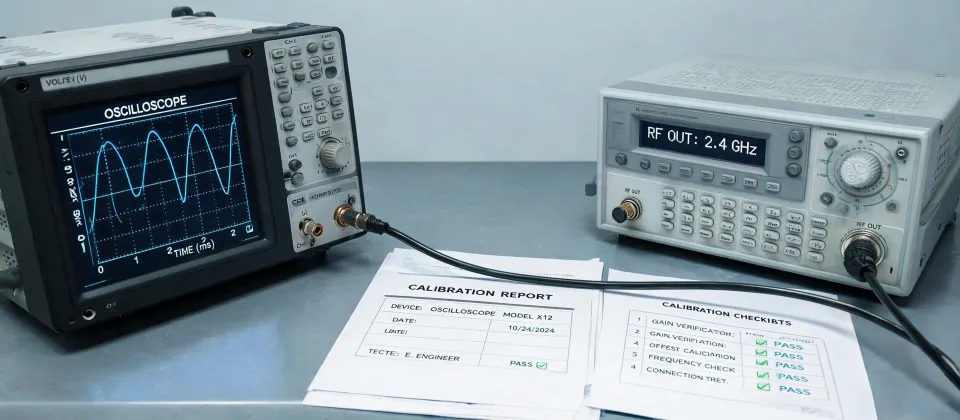
If you're equipping a small engineering team, skip the vintage Tektronix scopes. Get a handheld spectrum analyzer and a Fluke 117 true RMS multimeter first, and start the pressure gauge distributor search third—because that one will take longer than you think. That's the conclusion I wish someone had handed me in 2021, before I learned it through a series of expensive not-quite-mistakes. For 8 out of 10 small companies, this is the right shopping order.
Old scopes like the Tektronix 760A oscilloscope and the Tektronix 7854 oscilloscope still dominate surplus listings and engineer wishlists. They're classics. But "classic" is a word we use for things we admire, not for things we depend on in production. Most companies shouldn't buy them as a test team's primary scope.
Quick Context: Who's Doing the Buying
I'm the office administrator for a 45-person automation company. I manage purchasing across everything: laptops, hand tools, sensors, and test equipment. That works out to roughly $180k per year across 25-30 vendors, with 60-80 individual orders. When I took over purchasing in 2021, I knew almost nothing about oscilloscopes. I learned by buying things and getting burned a few times.
The engineers I work with are sharp. They're also terrible at remembering that purchased equipment has to be logged, calibrated, and actually power up when it arrives. That's my job to worry about. So my lens isn't "what's the best instrument theoretically." It's "what's going to work when the box lands on the loading dock."
The Vintage Tektronix Problem: 760A and 7854
The Tektronix 7854 is a 400 MHz waveform-processing oscilloscope from the 7000 series—a mainframe that took plug-in vertical amps and time bases, with a built-in waveform calculator. Announced around 1980, it was genuinely revolutionary for its time. The 760A is older and less documented. If you've been searching for a Tektronix 760A oscilloscope, you've probably noticed: the listings are vague, the photos are bad, and the descriptions hedge. "Works—I think." That should tell you something.
The Sales Pitch vs. The Reality
The sales pitch: "It was $20,000 new. I'm asking $400. Great deal." The reality: these units are 30-40 years old. CRTs dim. Capacitors drift. Plugin connectors corrode. And if it arrives broken, you're not shipping it back to Tektronix—they stopped supporting these decades ago. You're finding an independent repair shop that still knows analog circuits, and those people are retiring.
I don't have hard data on surplus-scope failure rates. What I can say anecdotally: we've been through three of them (a 760A and two 7854s). One arrived with a cracked CRT bezel. One had a trigger channel that dropped out below a certain voltage. The third worked. A 33% success rate is a bad gamble at any price.
And calibration is the hidden punchline. If you're using a scope for anything a customer will see, it needs calibration traceable to an accredited lab. ISO/IEC 17025 accredited calibration on a vintage 7000-series scope runs roughly $400-700—more than the instrument itself. (We learned that one the hard way.)
So why do these models keep getting recommended? Two reasons. Hobbyists and retro-computing enthusiasts genuinely enjoy restoring them, and engineers who used a 7854 in the 80s are recommending it out of nostalgia. Both are fine reasons to own one. Neither is a reason to buy one as your company's workhorse scope.
What I'd Buy Instead: A Handheld Spectrum Analyzer
This one surprised me, because I initially argued against it. Before 2023, we sent every RF-related request to an external lab. Three to four weeks of turnaround, every time.
I went back and forth for about a month between a cheap handheld spectrum analyzer (under $300) and a mid-range field unit. The cheap one looked great on a spreadsheet: same frequency range, same basic features, way less money. The numbers said buy it. My gut said something was off.
My gut was right. The budget vendor was slow to answer a simple question, offered no calibration paperwork, and couldn't tell me what an out-of-box failure would cost to fix. Responsiveness, it turned out, was a preview of the whole relationship. The mid-range unit we bought instead—from a distributor who sent the calibration certificate without being asked—paid for itself in eight months just in lab fees we no longer pay for initial screening.
Practical point: if you're troubleshooting RF noise, checking radiated interference, or verifying a device isn't emitting junk, a handheld spectrum analyzer gives you a field answer in minutes. It's not a benchtop replacement for certified lab measurements, but for 80-90% of the work a small team actually does, it's the tool that gets used.
How to Use a Fluke 117 True RMS Multimeter
"How to use Fluke 117 true RMS multimeter" is one of the most-searched strings in our analytics. The 117 is billed as an electrician's meter, but it ends up in every kind of business because it's the default "buy the good one" answer.
Three specific things matter when you're using it:
- Start in Auto-V mode. It senses AC versus DC automatically, so you don't need to guess the signal type before you probe it. That's not laziness—it's safety. Guessing wrong on a meter setting is how things get tested twice.
- Use LoZ mode to expose ghost voltages. If you read 30V on a wire that "shouldn't be live," switch to LoZ. A low-impedance input loads the circuit and collapses phantom readings from capacitive coupling. If it drops to zero, the wire was never actually energized.
- Trust true RMS with non-sinusoidal signals. Fluke's own application notes say true RMS responding meters are required to accurately measure non-sinusoidal waveforms. Average-based meters read distorted waveforms 10-30% low. VFD outputs, LED drivers, and switching power supplies are all distorted.
Example from real life: a customer complained a VFD-driven motor wasn't getting enough voltage. A tech with a $49 meter said "voltage's low." The Fluke 117 said it was exactly nominal. Guess which reading was correct? The $49 meter was averaging a noisy waveform and reporting low.
That's the practical case for this meter. It's not sexy. It just tells the truth.
Now the honest boundary: the 117 is not a data logger, not a clamp meter, and you won't use it for four-wire resistance measurements or long-term trend logging. If that's your actual work, buy those tools too. But if you need one meter that does everyday electrical troubleshooting correctly, this is the right tool for 80% of situations.
Pressure Gauge Distributors: The Boring Purchase That Takes Forever
Now for the least glamorous part of a test-equipment budget: pressure gauge distributors. Engineers will spend hours comparing oscilloscopes but pressure gauges are just… ordered. And that's exactly where we lost weeks of time.
We've dealt with distributors who couldn't give a straight lead time, who said "in stock" and meant "in stock at the factory," and one who shipped a supposedly certified gauge without calibration documentation. (Found that out when the customer asked for the report. Ugh.)
What I wish I'd done from day one: asked every distributor the same three questions. What's the actual lead time? Does the gauge ship with a calibration certificate? What's the return policy if it's wrong? The distributors who answer those in a single email are the ones who keep the account.
Where This Advice Stops Applying
Honesty requires boundaries. If you're a hobbyist, a ham radio operator, or a lab doing classic analog work, the vintage scopes—including the Tektronix 760A and 7854—may actually make sense. If you have someone on staff who enjoys restoring old gear, the risk equation changes completely. This is not a universal "all vintage scopes are bad" claim. It's a "most companies shouldn't buy them cold from a surplus listing" claim.
Same with the handheld spectrum analyzer. If you're delivering certified spectral data to a customer, get a benchtop unit calibrated by an accredited lab. The handheld is for screening and troubleshooting, not for authoritative characterization. And if you need to measure signals near its noise floor, it will flat-out mislead you. Don't push it where it doesn't belong.
And the Fluke 117? It's a great everyday meter, but it's not a complete metrology department. If you need logging, clamping, micro-ohms, or anything exotic, buy the tool that does that thing.
My experience is based on four years of purchasing for one 45-person automation company in industrial controls. Aerospace, medical devices, academic research—your lists will look different, and that's fine. The pattern is what generalizes: buy tools you'll actually use, buy from distributors who answer questions honestly, and don't let the romance of a 40-year-old bargain drive the decision.
Bottom line: the boring purchase is usually the right one. If someone tries to sell you a Tektronix 7854 as "the only scope you'll ever need," ask for the calibration certificate in writing. Spoiler: they won't have one.
Marcus Feld
Marcus Feld is an electrical test and measurement analyst specializing in multimeters, oscilloscopes, clamp meters, insulation testers, spectrum analyzers, and data loggers. He applies IEC 61010-2-030 and IEC 61010-031 concepts while examining measurement category, bandwidth, true-RMS response, input loading, and stated uncertainty. His work helps maintenance engineers and test teams choose safe instruments with performance suited to the signals and environments they actually measure.
Leave a technical comment