Industry guidance

Map the instrument choice to the review that follows the reading.

Different industries ask different questions of the same signal. A waveform captured for design debug, a spectrum trace used for network alignment, and a thermal image used for energized-work safety do not need the same evidence package.

Measurement instruments used across industries

Choose by operating context

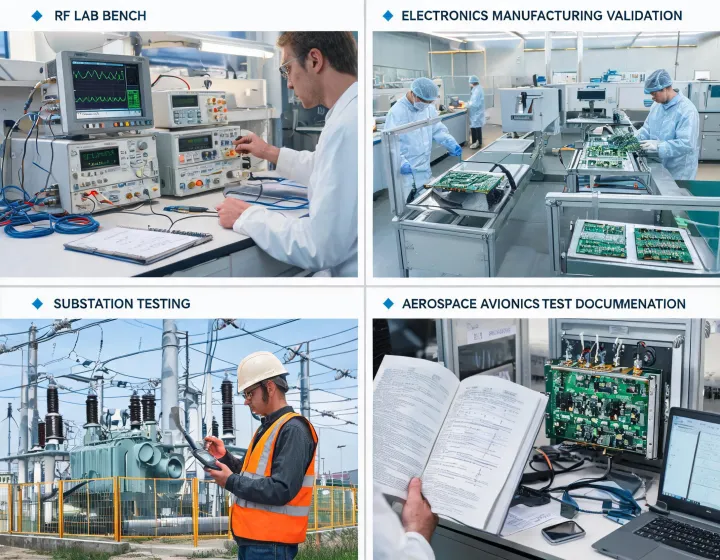
Power & Utilities

Substation acceptance, transformer commissioning, and power-quality work require instruments that tolerate field conditions while producing records a utility engineer can place in a project file. Insulation resistance, earth-resistance, and waveform capture should be matched to the voltage class, safety procedure, and expected acceptance threshold.

Electronics Manufacturing

PCB validation, EMC pre-compliance, and incoming inspection depend on repeatable setups. Oscilloscope bandwidth, probe loading, trigger strategy, and DC power measurement should be selected together so production teams can repeat the measurement without changing the claim.

Telecom & Network

5G base-station alignment, RF link verification, and fiber characterization ask for frequency coverage, dynamic range, protocol support, and clean reporting. The review should separate bench sensitivity from site conditions so acceptance criteria stay realistic.

Industrial Maintenance

Predictive maintenance teams use multimeters, clamp meters, and thermal imaging to decide when energized equipment can continue operating. Documentation should show the measured asset, method, environmental constraint, and practical safety limit rather than relying on a general inspection note.

Defense & Aerospace

Radar test, avionics box-level production, and electronic warfare programs need strict configuration control. The instrument set must preserve calibration files, firmware state, accessory selection, and measurement conditions because a repeat test may be required months later.

Selector guide for technical buyers

Begin with the signal and the consequence of a wrong reading. If the value releases a product, closes a safety work order, or supports a customer acceptance test, the quote should specify more than a model family. It should include range, bandwidth or frequency span, sample rate, probe or sensor interface, required accessories, calibration certificate type, and the region where the evidence will be reviewed.

Tektronix helps buyers separate mandatory requirements from preferences. For example, a portable oscilloscope may fit field work but need a different probe package than a bench scope used for signal-integrity validation. A spectrum analyzer used for base-station work may need options that do not matter in a teaching lab. That practical separation keeps budgets focused while protecting the measurement claim.

Application review

Send the industry context before choosing the instrument.

The same product family can serve very different approvals. Share the environment, decision threshold, and documentation need so the response can narrow the configuration with less rework.