Why I Always Ask "What's Not Included?" Before Buying Test Equipment
Posted on 2026-08-05 by Marcus Feld
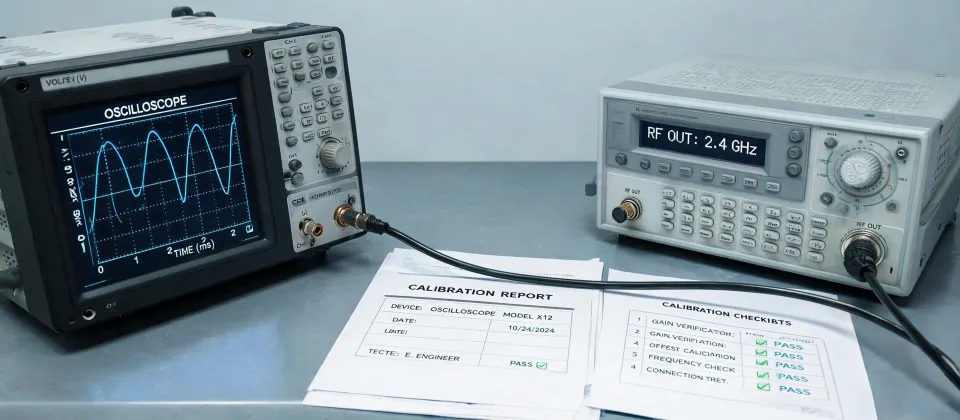
I'd rather buy a Tektronix oscilloscope at full price with every cost visible than accept a "deal" that hides half the expense until the first calibration bill. That's not a corporate talking point. It's the conclusion I reached after four years of reviewing test equipment for a living—and after paying the "cheap" tax on my own projects.
I'm a quality/brand compliance manager at a test and measurement company. I review roughly 40 equipment items each month before they move to customers. In Q1 2024, I rejected 14% of first submissions because their documentation didn't match the instrument. Not because the gear was visibly broken. Because the vendor said "calibrated" and meant "it powers on." That difference is the whole story.
The Sticker Price Is Not the Price
Take the Tektronix oscilloscope 2465. Used listings often show $350–$700 (based on public marketplace listings, January 2025; verify current prices). That's a 350 MHz analog scope that was a lab workhorse in the 1980s, and it can still do a lot. But the total cost of owning one depends on what the listing doesn't say.
In 2023, I bought a 2465 for $450. The seller said "fully tested." It powered on. It failed vertical accuracy on the 10 mV scale. A calibration house charged me $380 to adjust it, plus $95 for a matching probe. Total: $925. I thought I saved maybe $300; I ended up roughly at market price for a newer scope with a warranty. And I lost two weeks of waiting.
The Tektronix 2232 oscilloscope follows the same pattern. In early 2025, used asking prices were often below $300. It's a 100 MHz digital/analog hybrid with a sharp CRT and a still-useful display. But I've examined one where the battery-backed RAM was dying and the control membrane was flaking. Repair quotes ran $250–$450. The $280 "bargain" was a $730 lesson.
This is where I first learned to ask what's not included. In the inspection world, "calibrated" is a promise. On eBay, it's a guess.
The Same Trap Applies to Sensors and Clamp Meters
Some engineers think scopes are unique. They're not. I ran a comparison of the inductive proximity sensor M30 x 1.5 in late 2024. Two sensors with identical part numbers, same price, one from a reputable industrial distributor, one from an online reseller. The first stayed within 0.2 mm of its set switching distance over 24 hours. The second drifted 1.1 mm after one hour. Same specifications. Same claimed IP67. Very different measurement trust. The data sheet didn't tell you which one you'd get.
The same logic applies to a dc clamp meter. A $25 unit can show a plausible number. But if it's not shielded from adjacent conductors, your reading can be off by 3–5%—enough to miss a motor's increasing load until the bearing fails. I'd rather pay $120 for a meter with a published accuracy spec and a calibration certificate than save $95 and spend a full shift re-measuring everything.
I also learned this through a communication failure. I said "calibrated clamp meter" to a supplier. They heard "works well enough." When we got it in, the unit was within factory spec but had no certificate and no traceable calibration date. To us, that's the same as uncalibrated.
Calibration Is the Real Hidden Line Item
Nowhere is this more obvious than with pH measurement. When someone searches how to calibrate pH meter Mettler Toledo, the typical answer is: "Use buffer 4 and 7, press CAL, done." That's the outline—but not the process. According to Mettler Toledo's own guides, you need fresh buffers, temperature compensation, and a healthy electrode. You also need to verify the electrode's response time and slope. If your electrode is old, a two-point calibration won't fix it.
Add the paperwork. In a quality system, calibration means as-found values, as-left values, traceability to a standard, and a certificate. That takes time and money. A Mettler Toledo bench pH meter can cost $350–$800 (based on the last few quotes I've reviewed). A proper calibration kit with purchased buffers and certified references can add another $100–$250 per year. The meter price is meaningless if you never factor in the thing that makes it useful.
I'm not picking on pH meters. The same hidden cost applies to a Tektronix scope, a dc clamp meter, or an inductive sensor. If the quote doesn't say calibration, expect to write another purchase order.
"But I Don't Need Calibration"—Yes, You Do
I know what some of you are thinking: "I'm not in a regulated lab. I'm only fixing boards on my own bench. I don't need calibration."
I've been there. In 2020, I thought my old scope was fine because it displayed a clean sine wave. Then I used a known current source to check a dc clamp meter and found an 11% error. The meter had been dropped. The display was fine. The measurement wasn't. If you don't have an independent reference, you don't know.
The most expensive part of cheap test gear isn't the purchase. It's the doubt it introduces. You spend hours chasing a "fault" that's actually your instrument's drift. You miss a marginal capacitor because your probe's bandwidth was lower than you thought. You debate a vendor's rejection because you can't prove your reading was right. That cost is real. It's just not on the invoice.
When the vendor says "calibrated," ask for the certificate. When they say "works fine," ask what that means. The answer will tell you everything.
What I Do Now
After the 2023 Tektronix oscilloscope 2465 incident, I changed my process. Three rules:
- I ask "what's not included?" before "what's the price?" If the vendor can't list calibration status, certificate availability, and known issues, I assume the worst.
- I count calibration as a line item. If the tool needs it, the budget includes it. If it's included, great. If not, I know the real total.
- I verify before trusting. For the Tektronix 2232 oscilloscope or any legacy instrument, I check Tektronix's support site for service info. According to Tektronix's support documentation (tektronix.com), calibration is the process of verifying and adjusting an instrument to meet specifications. Verify legacy model service availability as of January 2025.
For sensors and meters, same thing: look for the certificate, the measurement standard, and the date. If you're comparing the inductive proximity sensor m30 x 1.5 or a dc clamp meter, treat the spec sheet as marketing until you have test data in hand.
This was accurate as of January 2025. The used market changes fast, and calibration rates vary by region, so verify current prices. My experience is based on roughly 200 lab and field instruments over four years; if you're in a regulated pharmaceutical or aerospace lab, your requirements will be stricter than mine.
I'll end where I started: the vendor who lists all fees upfront—even if the total looks higher—usually costs less in the end. I've learned that by paying the difference. Ask what's not included. Ask again. Then decide.
Marcus Feld
Marcus Feld is an electrical test and measurement analyst specializing in multimeters, oscilloscopes, clamp meters, insulation testers, spectrum analyzers, and data loggers. He applies IEC 61010-2-030 and IEC 61010-031 concepts while examining measurement category, bandwidth, true-RMS response, input loading, and stated uncertainty. His work helps maintenance engineers and test teams choose safe instruments with performance suited to the signals and environments they actually measure.
Leave a technical comment