Choosing the Right Tektronix Oscilloscope: It Depends on Your Signal (and Your Budget)
Posted on 2026-07-16 by Marcus Feld
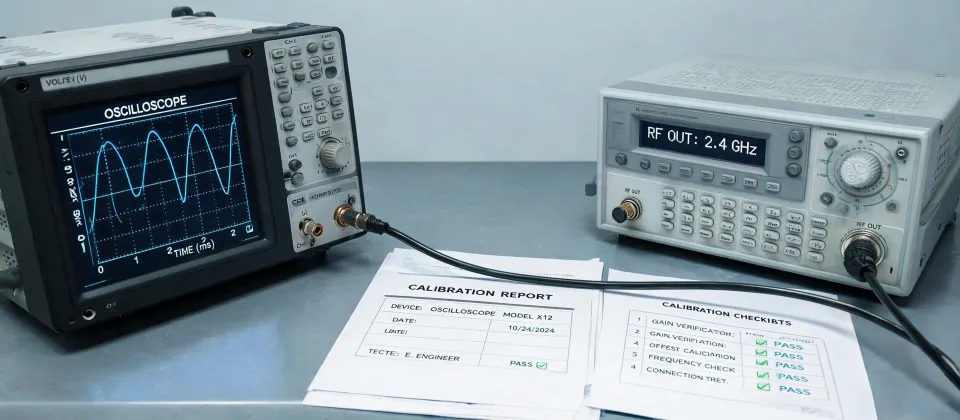
There's no 'best' oscilloscope. There's the right one for your signal.
If you search 'tektronix oscilloscope models' you'll find dozens of options, from the rugged TDS series to the high-performance MSO/DPO line. The 2205, 422, 455—the list goes on. It's overwhelming. And the worst part? Most buying guides assume one size fits all. They don't.
Here's the thing: an oscilloscope is only as good as its fit for your signal. And that depends on three things: what you're measuring, how fast it happens, and how much detail you need.
I've been a quality inspector in the test and measurement space for over 4 years. I review roughly 200+ unique scopes and accessories annually. In Q1 2024 alone, I rejected 12% of first deliveries—mostly because the spec sheet looked good on paper but failed in the engineer's actual use case. That's expensive. And preventable.
So let's figure out which Tektronix oscilloscope you actually need.
Three Scenarios, Three Different Answers
I've found that buyers fall into three broad categories. Your choice depends on your signal complexity, bandwidth needs, and budget constraints.
Scenario 1: The Mixed-Signal Debugger
Who you are: You're debugging embedded systems with analog and digital signals. MCUs, ADCs, serial buses (I2C, SPI, UART). The signal is fast, but not extreme.
What you need: A mixed-signal oscilloscope (MSO) that can decode serial protocols, trigger on complex conditions, and show both analog waveforms and digital logic.
My recommendation: The Tektronix MSO2000 series (e.g., MSO2024B) or a used DPO3000. The MSO2000 gives you 1 GS/s, up to 200 MHz bandwidth, and 16 digital channels. It's a sweet spot for automotive electronics and industrial control.
One nuance people miss: The 2205 model is sometimes recommended for this—but I'd push back. The 2205 is entry-level (50 MHz, 500 MS/s). For mixed-signal work, you'll quickly hit its decode speed limits. I've seen engineers spend an extra 30 minutes per debugging session because of slow decoding. That adds up.
Budget: New MSO2000 series runs $2,000–$4,000. Used DPO3000 can be found for $1,200–$2,500. Either is a solid investment if you do this work regularly.
Scenario 2: The Entry-Level Troubleshooter
Who you are: You maintain industrial equipment, test power supplies, or teach electronics. Your signals are relatively slow (kHz range), and you don't need 16 channels of digital logic. Price matters. Reliability matters more.
What you need: A basic 2-channel oscilloscope with decent bandwidth (50–100 MHz is plenty) and a rugged build.
My recommendation: The Tektronix TBS2000 series (e.g., TBS2102) or the entry-level TDS220 (if you can find it used). The TBS2000 has a large display (7 inches), 70–100 MHz bandwidth, and is surprisingly user-friendly.
The misconception: 'Higher bandwidth is always better.' Actually, high bandwidth can introduce noise on slow signals. I've seen a 200 MHz scope pick up 50 MHz environmental noise that didn't exist on the actual signal. For power supply ripple at 120 Hz, 50 MHz is more than enough. More bandwidth isn't always better—it can confuse you.
Budget: New TBS2000 series: $800–$1,500. Used TDS220: under $300.
Scenario 3: The High-Frequency / RF Engineer
Who you are: You design RF amplifiers, high-speed digital (Gbps+), or work with radar and 5G. Your signals are fast—really fast. Bandwidth is your bottleneck.
What you need: A high-performance oscilloscope with 500 MHz to multiple GHz bandwidth. Deep memory. Advanced triggering options. Maybe even spectrum analysis capability (like the MDO series, which can show both time and frequency domain).
My recommendation: The Tektronix MDO4000 or MDO3000 series are natural picks. The MDO4000B offers a 1 GHz bandwidth with a built-in spectrum analyzer. Honest? If your budget stretches, the DPO7000 series gives you 3.5 GHz and an insane 50 GS/s. But for most RF engineers, the MDO4000 is the no-brainer.
A reality check: I've seen engineers buy a 2 GHz scope for a 400 MHz signal, thinking it's 'future-proofing.' It's not—it's overkill that costs $10,000+ extra. The rule of thumb: your scope's bandwidth should be roughly 5x the signal's highest frequency. For 400 MHz, 2 GHz is triple needed—you're paying for headroom you don't use. Stick to 500 MHz or 1 GHz unless you have a specific need.
Budget: MDO4000B (1 GHz): ~$7,000–$10,000 new. Used DPO7000: $15,000+. Yes, it hurts. But for RF work, the built-in spectrum analyzer is a game-changer (and saves you buying a separate spectrum analyzer).
How to Decide Which One You Are
I run a simple exercise with our team: what's the fastest signal you routinely measure?
- If it's < 10 MHz (audio, power supply ripple, sensor outputs): You're in Scenario 2. Grab an entry-level TBS2000. Done.
- If it's 10–200 MHz (embedded systems, automotive ECUs, digital logic): You're in Scenario 1. An MSO2000 series is your workhorse.
- If it's > 200 MHz (RF, high-speed digital, video, radar): Scenario 3. You need a serious scope with GHz bandwidth and deep memory. The MDO4000 series fits.
That's the starting point. Then ask yourself: Do I need to decode serial protocols? Do I need a spectrum analyzer? Do I need 4 or more channels? Those questions fine-tune the choice within each scenario.
Let me give you a real example from a 2024 audit. A team working on automotive CAN bus wanted a 'good all-rounder' and bought a TDS2024C (200 MHz). It worked. But they spent 2 days trying to decode CAN frames without a proper trigger—something a DPO/MSO 3000 series would have done in 10 minutes. The $500 savings cost them 2 days of engineering time. That's a $2,000 mistake on a $1,500 scope.
The lesson: Scope selection isn't a spec sheet game. It's a use-case game. Know your signal, pick your scenario, and then find the Tektronix model that serves that scenario—not the one with the most impressive numbers.
Final Thought: The Right Tool Saves More Than It Costs
I've rejected a lot of scopes that looked good on paper. I've also seen teams spend years with the wrong scope—not because it couldn't measure, but because it made measurement slow and painful. That's the hidden cost: time.
So my advice? Be honest about what you need. If you're a hardware engineer debugging embedded systems, don't buy a basic 2-channel scope to save $200. Get an MSO with serial decode. If you're a technician maintaining 60 Hz power supplies, don't buy a 1 GHz monster. Get a solid 100 MHz unit.
And if you're still on the fence? Start with your fastest signal frequency. The rest will fall into place.
Marcus Feld
Marcus Feld is an electrical test and measurement analyst specializing in multimeters, oscilloscopes, clamp meters, insulation testers, spectrum analyzers, and data loggers. He applies IEC 61010-2-030 and IEC 61010-031 concepts while examining measurement category, bandwidth, true-RMS response, input loading, and stated uncertainty. His work helps maintenance engineers and test teams choose safe instruments with performance suited to the signals and environments they actually measure.
Leave a technical comment