Your Practical Checklist for Buying Test Equipment (from someone who manages the orders)
Posted on 2026-07-16 by Marcus Feld
-
Step 1: Define the Actual Measurement Need (Not the Model Number)
-
Step 2: Total Cost of Ownership — Not Just the Sticker Price
-
Step 3: Match the Brand to the Application — No Blind Loyalty
-
Step 4: Ensure Training Resources Are Available
-
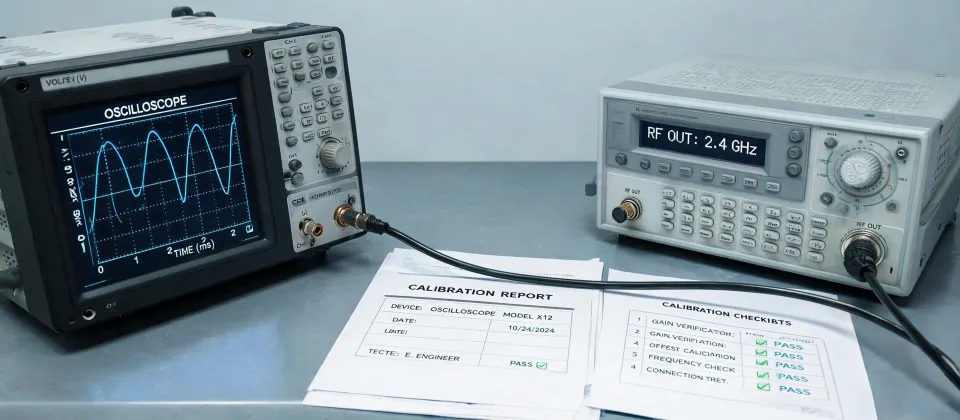
Step 5: Validate Before You Accept Delivery
-
Common Mistakes to Watch For
If you're the person in your company who actually places the orders for test equipment — oscilloscopes, multimeters, digital microscopes, megger insulation testers — you know it's not as simple as clicking 'buy'. Engineers throw specs at you, finance wants a quote under budget, and somewhere in between you have to make sure the thing works when it arrives.
I've been managing equipment purchases since 2020, roughly $80k annually across 7 vendors. This checklist is what I follow every time. Five steps. Skip one and you'll likely regret it.
Step 1: Define the Actual Measurement Need (Not the Model Number)
The most common mistake? An engineer says 'I need a Tektronix MDO3024 oscilloscope'. You search, you buy. But that scope costs around $4,500. When it arrives, it turns out they only needed a basic USB oscilloscope for troubleshooting 100 MHz signals — a Tektronix USB oscilloscope at $800 would have done the job. That $3,700 difference came straight out of our department's budget.
What to ask instead:
- What signal are you measuring? Frequency, voltage, protocol?
- Do you need mixed-domain analysis (time + frequency) or just basic waveform capture?
- Portable for field work or benchtop only?
If the application is simple (like checking a power supply), a Tektronix USB oscilloscope like the 2-series is plenty. If they're debugging RF and digital simultaneously, the MDO3024's spectrum analyzer integration saves time. But never assume — ask the three questions above. Trust me on this one.
Step 2: Total Cost of Ownership — Not Just the Sticker Price
I learned this the hard way. In 2022, I ordered what looked like a great deal on a multimeter for an electrician team. The price was way lower than the 'best multimeter for electricians' lists suggested. Three months later, three of them failed calibration. The re-calibration cost per unit was $120 — and we had 12 units. That's $1,440 I hadn't planned for.
Account for:
- Calibration cycles (annual? biennial? factory-only or third-party?)
- Probes, adapters, software licenses (a spectrum analyzer often needs additional measurement bundles)
- Training resources — if you're buying a megger insulation tester, your team needs to know how to use megger insulation tester safely. Tektronix offers free primers and application notes, which saves us training costs.
Honestly, I'm not sure why some vendors hide these costs so well. My best guess is they want the initial quote to look low. Now I always request a 'fully loaded' quote that includes shipping, calibration, and a spare probe.
Step 3: Match the Brand to the Application — No Blind Loyalty
People think expensive brands always deliver better quality. Actually, brands that deliver quality can charge more. The causation runs the other way. For oscilloscopes, Tektronix is a strong choice — they've been at it for decades, and their application support is solid. For multimeters, what is the best multimeter for electricians? Depends on whether you're doing CAT III safety work (Fluke is a standard) or general lab bench measurement (a high-value brand may suffice).
If the task is visual inspection, a digital microscope might replace a traditional optical microscope for PCB rework. Tektronix doesn't make digital microscopes — but many vendors do. Here's my rule: pick the vendor that has the best documentation and support for your specific use case. A digital microscope with a stand and HDMI output is useless if the software doesn't run on your company's locked-down laptops.
I've never fully understood why some procurement managers insist on single-vendor sourcing for everything. If you need a Tektronix scope, buy a Tektronix scope. But for a multimeter or digital microscope, don't force a brand mismatch just because it's the same supplier.
Step 4: Ensure Training Resources Are Available
Equipment is only as good as the person using it. When I ordered our first megger insulation tester (a 5kV unit from a reputable brand), nobody on our maintenance team had used one before. The manual was 200 pages. We wasted three days figuring it out.
Now I check: does the vendor provide application notes, video tutorials, or live training? Tektronix publishes free 'fundamentals primers' for oscilloscopes, which makes onboarding new engineers way easier. For the megger, I found a manufacturer that offered a one-hour webinar — we scheduled it for the whole team before the unit even arrived.
If your team searches 'how to use megger insulation tester' on YouTube, the videos should match the model you bought. (Should mention: verify that the training covers your exact model, not a generic older version. I made that mistake once.)
Step 5: Validate Before You Accept Delivery
It's easy to sign the packing slip and move on. Don't. Set up a 7-day validation period:
- Power on and run a self-test
- Test with a known signal (e.g., a 1 kHz square wave from a function generator for the oscilloscope)
- Check all accessories against the packing list
- For a digital microscope, capture an image and verify resolution against the spec sheet
In Q4 2023, we received a Tektronix MDO3024 that passed the self-test but had a dead channel when probing a live signal. Because we tested within 7 days, we got a replacement shipped overnight — no questions asked. If I'd waited until the end of the quarter, we'd have been stuck with a repair cycle.
Common Mistakes to Watch For
- Only comparing list prices — volume discounts are real. Ask for a quote, not a catalog price.
- Ignoring software compatibility — some digital microscopes require USB 3.0 and specific codecs. Check your IT policy.
- Assuming all Tektronix oscilloscopes are the same — the USB oscilloscope series is great for field work but lacks the deep memory of the MDO3000 family. Pick the right tool, not the cheapest or most expensive.
- Skipping calibration verification — especially for insulation testers. A megger that reads incorrectly can be a safety hazard.
That said, this checklist works for 80% of our purchases. If you're dealing with a one-off custom test setup or MIL-spec requirements, your process will differ. But for standard lab and field equipment — oscilloscopes, multimeters, digital microscopes, megger testers — following these five steps has saved me hundreds of hours and tens of thousands of dollars. Take it from someone who's been burned more than once.

Marcus Feld
Marcus Feld is an electrical test and measurement analyst specializing in multimeters, oscilloscopes, clamp meters, insulation testers, spectrum analyzers, and data loggers. He applies IEC 61010-2-030 and IEC 61010-031 concepts while examining measurement category, bandwidth, true-RMS response, input loading, and stated uncertainty. His work helps maintenance engineers and test teams choose safe instruments with performance suited to the signals and environments they actually measure.
Leave a technical comment