Choosing Between a Tektronix Handheld Multimeter and an Oscilloscope When Every Minute Counts
Posted on 2026-08-07 by Marcus Feld
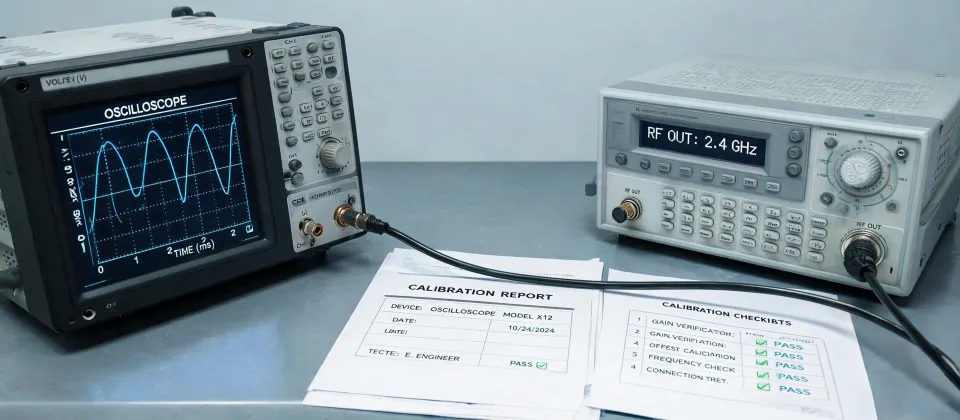
There's no one "right" Tektronix tool. It depends on the question you're asking, and on how much time you have left before the deadline hits. In my world, it's pretty much a decision tree.
I'm a senior applications engineer at an independent calibration and repair house. I've handled 200+ rush orders in eight years, including same-day turnarounds for semiconductor and industrial manufacturing clients. When a production line is down, the fastest fix isn't usually the fanciest one—it's the most honest one. The right tool matters, but "right" changes with the situation.
In practice, I see three common scenarios: a level check where you only need a number, a signal problem where you need to see the waveform, and an "I'm not sure where to start" situation where the real gap is knowledge. The three sections below walk through each one.
Scenario 1: When the Answer Is a Number — Tektronix Handheld Multimeter
You need to know: "Is this rail powered?" "Is this fuse blown?" "Is this encoder getting its supply voltage?" That's a level question. The answer is a reading, not a waveform.
For that, a Tektronix handheld multimeter is the fastest tool in the room. No trigger setup, no probe compensation, no timebase. Connect, read, decide. It's the engineering equivalent of taking a pulse before running an ECG.
Here's the counterintuitive part: a high-end oscilloscope will only slow you down in this scenario. Just getting a voltage probe set up correctly can take longer than a complete DMM measurement. I've watched engineers untangle scope leads while a simple meter would have given them the same answer in seconds (which, honestly, is a hard thing to admit when you love scopes as much as I do).
The remote display feature is one of the underrated time-savers. If your Tektronix handheld multimeter has a remote display option—or pairs with a smartphone app—use it when you need to keep the reading visible while both hands are on the probes. The first time I used that setup, I cut a repeatable measurement cycle from about 90 seconds to maybe 25. That matters when a client is staring at a stopped line.
Realistic case: In March 2024, 36 hours before a client's production line was supposed to restart, they called with a dead conveyor. I grabbed a Tektronix handheld multimeter, confirmed the 24 V sensor rail was missing, traced it to a $1 fuse, and had them ordering the spare part before I was back in the car. A scope would have shown the same thing—just not faster.
Scenario 2: When the Answer Is a Picture — How to Use a Tektronix Oscilloscope
Now the other side. Actually, let me rephrase: this is the side where a multimeter can start to lie. If the signal exists but isn't behaving—missing pulses, bad timing, a glitch, slow edges—a DMM won't just be slow; it can be misleading.
A DMM averages voltage. It gives you a single number and hides the shape behind it. Last quarter alone, we processed 47 rush measurement jobs with 95% on-time delivery, and every single "intermittent signal" case required an oscilloscope. You can't "hear" a missing pulse with a multimeter.
Example: A factory's filling machine was losing position. The tech on site tested the DBS60 encoder with a multimeter, saw 5 V DC at the supply, and told me the encoder was dead. We were using the same words—"the encoder is bad"—but meaning different things. He meant "the multimeter reading looks wrong." I meant "which channel is missing?" Discovered this when the scope showed a clean supply voltage and a missing channel-A pulse train. The encoder wasn't dead; it had a damaged connector that only dropped pulses at higher speed.
If your problem is in the behavior of the signal, the question is visual. Learn these three basics of how to use a Tektronix oscilloscope under time pressure:
- Ground first—connect the ground lead before you touch the probe tip to anything.
- Set vertical, then horizontal—use volts/div to fit the signal, then time/div for the time window you need. For a 1 kHz encoder pulse train, 2 ms/div is a good starting point.
- Trigger deliberately—for an encoder, trigger on channel A or the index pulse. This is the step that separates a stable waveform from a blur (and, honestly, where most time gets lost).
If you're dealing with an encoder like the DBS60 specifically, don't stop at the supply voltage. Verify channel A/B and the index pulse with a scope before you order a replacement. I've seen too many "dead encoders" that were actually wiring faults. One detail from that job: the scope's calibration sticker was current, which mattered when we documented the waveform for the client's records. Traceability to NIST is the part nobody sees until the reading is challenged.
The best quick reference for this is Tektronix's own "XYZs of Oscilloscopes" primer. According to Tektronix's educational library (tek.com/library), this primer has been the standard introduction to oscilloscope fundamentals for decades. It's a free PDF—just search "XYZs of Oscilloscopes" on tek.com—and it reads like it was written by a skilled teaching assistant, not a marketing team.
Scenario 3: When the Gap Is Knowledge, Not Hardware
Here's the scenario people won't admit to until they're deep in a time panic: you're about to measure something, but you're not 100% sure how to set up the instrument or what the result should look like. When that's the situation, the missing piece is a 20-minute read, not a bigger budget.
The "tektronix xyzs of oscilloscopes primer pdf" isn't just for first-time users. I've used it for years, and I still reopen it when I need to remember the exact procedure for probe compensation or a subtle trigger method. It reads like it was written by a skilled teaching assistant, not a marketing team.
So here's the unpopular under-time-pressure recommendation: if you have two hours and you're shaky on scope fundamentals, spend the first 20 minutes rereading the primer before you turn knobs. I know it feels like wasted time. It's not. The signal will still be there in 20 minutes; your confidence will be a lot higher.
Granted, this takes discipline—especially when the phone is ringing and someone is waiting. But I learned that the hard way. In 2023, I skipped my own rule during a rush sensor verification and burned an hour fighting the trigger. That hour killed any time savings I might have gotten. Since then, our internal policy is: review before you probe, even under pressure.
Which Scenario Are You In?
Here's how to sort yourself in about 30 seconds:
- Can your question be answered with a number or a "yes/no"? It's a level problem. Reach for the Tektronix handheld multimeter. Use the remote display if you have it, and don't feel bad about not dragging in a scope.
- Does the problem involve timing, shape, glitches, or intermittent behavior? It's a waveform problem. Set up the oscilloscope and, if you're unsure about the trigger, pull up the XYZs primer.
- Are you not even sure how to phrase the measurement question? Stop and review the fundamentals first. The fastest way through an emergency isn't always grabbing an instrument; it's making sure the instrument can give you an answer you can trust.
If you're still torn, ask what a wrong reading would cost. A multimeter that gives a single clean number can be dangerously misleading if the real problem is a pulse train that disappears under load. The consequence isn't just a wasted morning—it can mean ordering the wrong part, losing a client's trust, and explaining a penalty clause that's way bigger than the fuse you were looking for.
Bottom Line
Your choice of tool under deadline shows up in the quality of your report. A clean, properly triggered scope capture tells a client "this was diagnosed by someone who knows what they're doing" in a way that a scribbled DMM reading can't. That's not vanity; it's credibility. The instrument you pick isn't a status symbol—it's part of your brand.
My experience is based on about 200 mid-sized urgent jobs in manufacturing and lab support. If you work in a different segment—pure R&D, broadcast, aerospace—your balance might shift. The principle stays the same: match the measurement to the question, don't let a scope intimidate you, and don't let a multimeter oversimplify a timing fault.
And check the current Tektronix lineup before you rely on any feature mentioned here. This was accurate as of early 2025: many Tektronix handheld multimeter models offer a remote display path, but product lines evolve. The gear I used in the stories above may not be the current model—but the decisions are still the same.
Time is the one component you can't order overnight. Spend it where it actually answers the problem.

Marcus Feld
Marcus Feld is an electrical test and measurement analyst specializing in multimeters, oscilloscopes, clamp meters, insulation testers, spectrum analyzers, and data loggers. He applies IEC 61010-2-030 and IEC 61010-031 concepts while examining measurement category, bandwidth, true-RMS response, input loading, and stated uncertainty. His work helps maintenance engineers and test teams choose safe instruments with performance suited to the signals and environments they actually measure.
Leave a technical comment