Buy vs Rent Test Equipment: A $350 Tektronix Scope Cost Me $1,200
Posted on 2026-08-07 by Marcus Feld
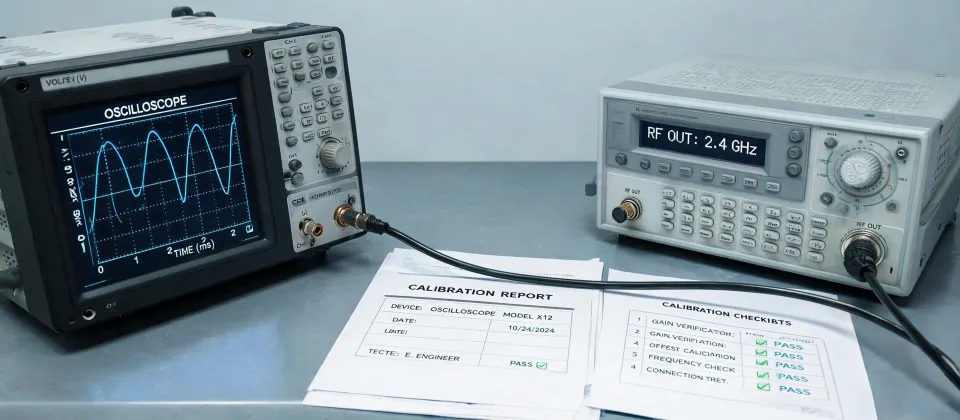
If you're like me, you collect test equipment. My bench at home is full of gear I bought because "it was a good deal." Some of it earned its place. One piece — a vintage Tektronix 2232 oscilloscope — nearly cost me a client.
In this article, I'll compare two ways of getting test equipment: buying (especially used and vintage gear) vs renting (modern, calibrated equipment). I've done both, and I've made expensive mistakes in both directions. My goal is to give you a framework so you don't repeat them.
The $350 Scope That Wasn't a Deal
In January 2023, I bought a Tektronix 2232 oscilloscope from an online auction. Classic 100 MHz analog/digital hybrid, and a legendary model in its day. $350 plus shipping. The photos looked clean. The seller said "works great."
I said, "Maybe it needs a quick calibration." They heard, "I'll accept it as-is." Result: one channel had a trigger jitter problem that only showed up under specific conditions. The conditions I needed three weeks later.
I was on a deadline. A client needed time-domain reflections characterized on a control signal. I set up the 2232, and the waveform looked like a pair of dancing snakes. Not the signal. The timebase. Jitter.
I spent two days trying to work around it before giving up. Rented a modern scope for $400 for the week. Job done in one afternoon.
Let's count: $350 for the scope, $180 in shipping, $400 in rental, and roughly $1,200 in wasted labor and my client's patience. Worst deal of my career.
Lesson number one: the purchase price is not the total price. Old Tektronix gear is loved for good reasons. The 2232 had a genuinely impressive feature set for 1989. But it's a 35-year-old instrument. Capacitors age. Trigger circuits drift. And calibration support for vintage models gets harder to find every year.
To be fair, some used specimens are perfectly fine, especially for hobby work. But when a date is on the calendar and a signature is on an agreement, "probably fine" is not a plan.
The Framework: Three Questions
Here's the thing: there is no universal "buy is better" or "rent is better" answer. I now compare along three dimensions:
- Total cost over the window I actually need the instrument
- Calibration certainty — and the documentation to prove it
- Is it the right tool for the job, period
The third one surprises people. It's also the one I got most wrong.
Dimension 1: Total Cost Over the Window You Need It
The purchase side
My Fluke 287 true RMS multimeter: I own this one, and I'll defend it until it dies. It's out there in the field with me several times a week. I paid $420 in 2021, and it has long since paid for itself. If you use a tool constantly, ownership wins. This isn't even a contest.
But I also bought a thermal camera once. $2,100. Used it twice in six months. The second time, the readings looked off. I didn't know how far off until I compared it side-by-side with a rental unit. The calibration had drifted.
The rental side
Thermal camera rental: a mid-tier unit with current calibration documentation runs roughly $300–500 per week, depending on model and rental house (based on quotes I collected in late 2024; verify current rates). If I need it for one site audit, that's $450. Not $2,100 — and it comes with a calibration certificate.
The gap narrows fast if you shoot thermal images monthly. Then you probably should own one, or negotiate a long-term rental.
Dimension 2: The Certainty Premium
In March 2024, I had a compliance measurement that needed a spectrum analyzer — not just any spectrum analyzer, but one with documented calibration. I wanted to use the Tektronix spectrum analyzer RSA306B, a USB-based unit that turns a laptop into a real RF instrument. It's the kind of gear that makes you wonder why anyone lugs around a benchtop anymore.
The numbers said: buy a used RSA306B and save roughly $1,500. My gut said: rent it with current calibration documents. Went with my gut.
Why? Because a rental unit from a decent lab comes with a calibration certificate dated last month. A used unit comes with one from two years ago — if you're lucky. Recalibration for a spectrum analyzer costs a few hundred dollars and can take a week or more. And if the used unit fails its first verification, you're back to square one with a deadline approaching.
A certificate from a lab accredited to ISO/IEC 17025 is a documented chain of traceability — it's what auditors actually check. That's the certainty premium.
Here's the thing: the rental was $520 for the week. The used unit was $1,200 cheaper. But the project had a hard stop. Real talk: an instrument whose calibration you can't prove is a risk, not an asset. The audit passed. The certainty was worth exactly what it cost.
"Probably calibrated" is the same as "probably not compliant" when you're under scrutiny.
Dimension 3: The Right Tool, Not Just A Tool
This is the dimension that hurt me most. Because it's not about money — it's about the difference between owning good tools and owning the right tool.
The Fluke 287 can't replace a megger
I remember the week clearly. A client asked me to check insulation on a motor that kept tripping the breaker. I packed my Fluke 287 — my favorite instrument in the world — and drove over. I had read somewhere that the 287 could measure insulation resistance. I told myself it would do fine.
Wrong.
A multimeter applies a low voltage to measure resistance. A Fluke 287, for all its true RMS glory, is not an insulation tester. Insulation testing requires a much higher test voltage — typically 250, 500, or 1000 V DC — to expose weak spots that only appear under electrical stress. At a multimeter's low voltage, a degraded insulation path can read perfectly healthy. Then it fails catastrophically later, under real operating voltage.
That afternoon, the client's senior tech handed me a megger and showed me the procedure. If you've never used one, here's the short version:
- Disconnect the equipment from power and from all other circuits. This is non-negotiable. A megger generates a hazardous voltage.
- Select the test voltage based on the equipment rating. For most industrial low-voltage gear, 500 V is the default. For higher-rated circuits, 1000 V. Your standard or nameplate should say.
- Connect the leads: one to the conductor, one to ground (or between conductors for an inter-winding test).
- Hold the test button until the reading stabilizes — typically 60 seconds. That value is the insulation resistance in megohms.
- Compare to the minimum. For rotating machinery, IEEE Std 43 recommends at least 1 MΩ per kV of the machine's rated voltage. Most healthy motors read far higher.
We tested the motor, and it failed badly. The megger revealed what the multimeter never could. The motor went out for rewind instead of burning out on a production line. Cost of the megger rental: $180 for the week. Value of the diagnosis: somewhere in five figures.
The lesson is not that the 287 is a bad meter. It's excellent. The lesson is that comparing a multimeter to an insulation tester is not even a comparison — they're different categories. I was using the wrong framework entirely.
The RSA306B and the "I'll grow into it" trap
I almost bought an RSA306B because I wanted to get deeper into spectrum analysis. It's a gorgeous instrument, and Tektronix's SignalVu software makes it genuinely useful in the field.
But I checked my calendar: I touch spectrum analyzers three to five times a year. At that rate, rental wins — on cost, on calibration, and on storage space. Granted, if I were an RF design engineer, the calculation flips instantly. Daily use? Buy it. And that's exactly why this comparison has no universal winner.
So: Buy or Rent?
After years of mistakes that total roughly $5,400 in wasted budget, here is the rule I now live by:
Buy it when:
- You'll use it at least monthly — my Fluke 287 fits here.
- Calibration drift won't land you in a compliance or safety problem.
- You can tolerate a week of downtime for service without losing sleep.
Rent it when:
- The job has to happen this week — the certainty premium is real.
- The customer or QA team expects calibration certificates.
- It's a one-off task. Thermal imaging is the textbook case. Spectrum analysis, for me, is another.
If you do take the vintage route — and I still cheer for old Tektronix gear on principle — budget as if the purchase is only a down payment. Add calibration, parts, and the honest probability that it will fail at the worst possible moment. Vintage gear is a hobby with benefits. Rental is not a hobby. It's a guarantee.
Look, I'm not saying rental is always right. For daily-use basics, buying wins. But the next time someone tells you "buying is cheaper," ask them: cheaper over what window, with what certainty, for what job?
Those are the right questions. I learned them the expensive way.

Marcus Feld
Marcus Feld is an electrical test and measurement analyst specializing in multimeters, oscilloscopes, clamp meters, insulation testers, spectrum analyzers, and data loggers. He applies IEC 61010-2-030 and IEC 61010-031 concepts while examining measurement category, bandwidth, true-RMS response, input loading, and stated uncertainty. His work helps maintenance engineers and test teams choose safe instruments with performance suited to the signals and environments they actually measure.
Leave a technical comment