Why Cheap Test Equipment Is More Expensive: A Tektronix Procurement Deep Dive
Posted on 2026-08-17 by Marcus Feld
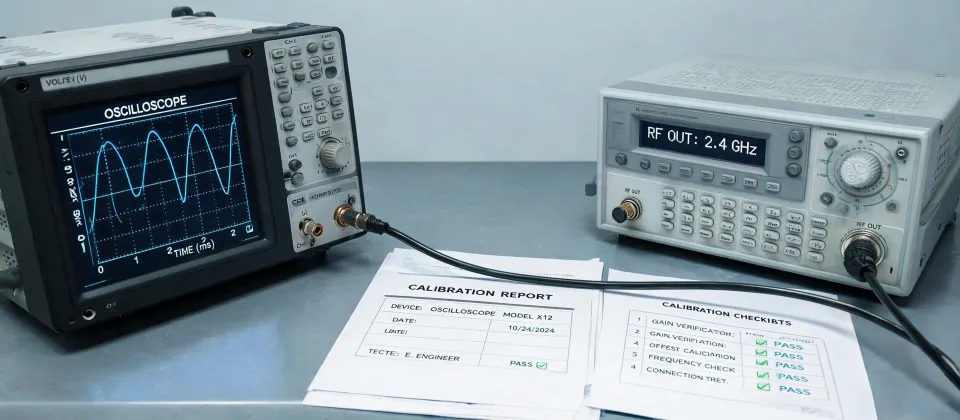
Let me start with something you've probably felt: test equipment budgets never stretch far enough. You search for "tektronix" because you want gear you can trust, then the price tag makes you wonder if a cheaper import can do the job.
I've been there. I've managed procurement for a 40-person engineering company for six years, and I've tracked $180,000 in test and measurement spending. The cheapest option almost never wins when you count the full cost.
The problem isn't the price tag. It's the hidden line items.
Everyone tells you to compare specs and prices. In my experience, the purchase price is the least interesting number on the spreadsheet. The interesting numbers are waiting behind the quote: leads, calibration, support, downtime, and the hours your engineering team burns chasing bad measurements.
The cheapest option is not the one with the lowest price. It's the one with the lowest total cost of ownership.
Three hidden costs I almost missed
1. Multimeter leads are not accessories
A set of cheap multimeter leads can add 0.5 ohm to every reading. On a low-resistance measurement, that's not a small error. It's a phantom failure.
We had a bench with a good 189 multimeter and a set of leads that looked fine. I spent two days chasing a voltage discrepancy between two boards. It was the leads. The ground lead had a cracked crimp and intermittent resistance. Replacing the leads fixed the problem. Looking back, I should have bought quality leads at the start. At the time, they seemed like an accessory, not an investment.
To be fair, cheap leads are fine for continuity checks. For measurement work, they're a gamble.
2. Cheap gear can be expensive to calibrate
When I compare calibration quotes, the lower-priced instrument doesn't always have the lower-priced calibration. Some vendors shift the cost into a mandatory annual calibration and proprietary software. You don't see that on the invoice until you own it.
In 2023, I audited our spending and found that 23% of our repair and calibration line went to rush fees on budget-priced meters and supplies. We weren't saving money. We were just moving it around.
3. Support and longevity matter more than the sticker
If you still have a Tektronix 466 oscilloscope in your lab, I understand. It's a legendary instrument. But support for the 466 is not what it was decades ago. Parts, probes, and calibration expertise get harder to source. Honestly, I'm not sure why we kept ours as long as we did. My best guess is familiarity. The cost of keeping a legacy instrument alive can exceed the cost of a modern entry-level scope.
Not ideal, but workable. That was my old attitude. It was wrong.
The deeper issue: total cost of ownership
Why does this matter? Because the spreadsheet doesn't lie.
We compared eight vendors over three months using a TCO model. One vendor had the lowest quote. Another was slightly higher. But after adding leads, calibration, support, and a one-year service plan, the second vendor came out 17% cheaper over three years. The "cheap" quote was actually a down payment on more expenses.
I've also seen the conventional wisdom fail in another direction: people assume premium gear always outperforms budget gear. For our specific use case, a mid-tier USB analyzer gave us 90% of what a bench analyzer would, at a fraction of the bench space and cost. The right answer is not the most expensive or the cheapest. It's the instrument you can actually maintain and support.
What ignoring this actually costs you
Let me give you a concrete example. A failed pre-compliance scan can cost $2,000 to $5,000 in lab time and redesign. If you're doing pre-compliance with an instrument that can't see emissions properly, you're not saving money—you're deferring it.
One solution is a Tektronix RSA306B USB spectrum analyzer. It's not the size of a benchtop unit, it travels well, and it lets a small team do real pre-compliance work before paying for an external lab. I'm not saying it replaces a $100,000 laboratory analyzer. I'm saying for a small engineering company, it changes the math.
Then there's the little stuff. The bad multimeter leads cost us three days of engineering time. At a loaded cost of about $80 an hour, that's $1,920. The leads were $9. The conventional wisdom is to always buy the cheapest consumable. My experience with 200+ orders says that advice is backwards.
What I do now: four questions before every purchase
Before I approve a test equipment purchase, I run four questions:
- What is the calibration interval, and what does it cost over three years?
- How long does support actually take, and what happens when the instrument misbehaves?
- What accessories are included—probes, leads, software, adapters, case?
- Can this instrument do the job today and scale when our needs change?
These questions work for any vendor. And yes, they work for Tektronix. Our first Tektronix order was small—two probes and a software option. The rep spent time with us, walked through the order, and didn't make us feel like a nuisance. Small doesn't mean unimportant. It means potential.
If you've ever searched "how to get eppendorf pipette pen", you know the same feeling: a vendor that sends a small branded pen with a follow-up note is telling you they see you, not just your purchase order. The pen isn't the point. The relationship is. And a vendor that treats small orders like real orders is the one you call when the big order finally lands.
If you ask me, the goal isn't to avoid spending money. It's to spend it where it actually improves your measurement and your team's time. A $9 set of leads is not a bargain when it costs $1,920 in engineering hours. A vendor that ignores small orders is not a partner. Buy the thing that makes your next measurement trustworthy—and treat the vendor relationship as part of the purchase.
This was accurate as of January 2025. The test and measurement market changes quickly, so verify current prices, specs, and calibration programs at tektronix.com before you commit to a budget.
Marcus Feld
Marcus Feld is an electrical test and measurement analyst specializing in multimeters, oscilloscopes, clamp meters, insulation testers, spectrum analyzers, and data loggers. He applies IEC 61010-2-030 and IEC 61010-031 concepts while examining measurement category, bandwidth, true-RMS response, input loading, and stated uncertainty. His work helps maintenance engineers and test teams choose safe instruments with performance suited to the signals and environments they actually measure.
Leave a technical comment