Used Tektronix Oscilloscope Buying Mistakes: Model History, Calibration, and a $3,200 Lesson
Posted on 2026-08-10 by Marcus Feld
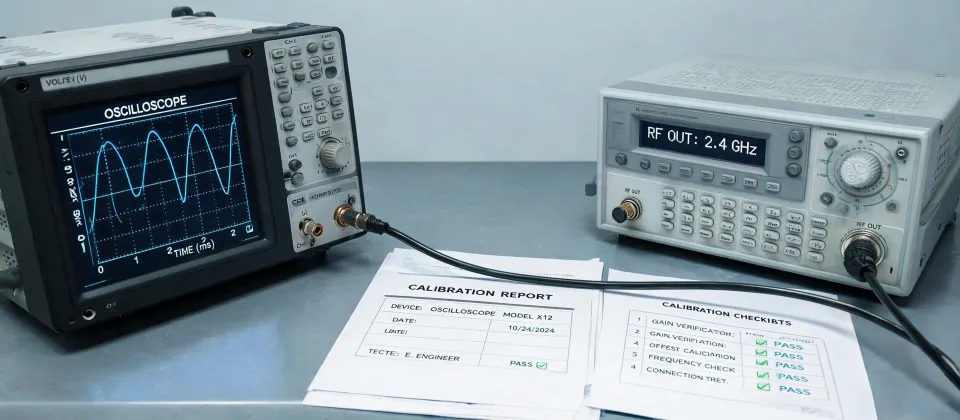
Bottom line first: before you even search for any used Tektronix oscilloscope for sale, define the exact model family and verify the About screen. A $3,200 mistake taught me that the hard way.
I'm a senior instrumentation engineer. For the last eight years, I've been the person who signs off on incoming test gear — everything from oscilloscopes to thread micrometers. I do not say that to impress you. I say it because I've made fourteen documented purchasing mistakes in that time, totaling roughly $18,000. The biggest disaster involved a used Tektronix DPO, and it happened because I didn't pay enough attention to Tektronix oscilloscope model history.
Why Tektronix oscilloscope model history matters
The old rule of thumb was that Tektronix scopes never die. That was true for analog tanks like the 465 and 475, where the worst-case problem usually involved a cracked CRT. It is not true for digital scopes. A modern used Tektronix oscilloscope is basically a computer with a high-speed acquisition front end. It has firmware, boot diagnostics, installed options, and proprietary ICs. A model number like TDS 220 or DPO 4054 is not a decoration. It maps directly to bandwidth, channels, sample rate, and hidden features you might not see in a listing photo.
Surprisingly, many listings skip the option table. Honestly, I'm not sure why some sellers do not post it. My best guess is that they don't know it exists. But if you search Tektronix oscilloscope model history before placing a bid, you can decode what those numbers mean. A TDS 220 is a 100 MHz, two-channel DSO from the late 1990s. A DPO 4054 is a 500 MHz, four-channel scope from a much later generation. Both are Tektronix. Neither is interchangeable. Model history tells you which one, when it was made, and what it was intended to do.
The mistake happened in 2022. I went back and forth for two weeks between a new entry-level scope and the used DPO. The new one had a warranty. The used one had bandwidth. The seller posted clean photos, an exact serial number, and a note saying it was 'pulled from a working lab.' The auction ended on a Tuesday. I had two hours to decide. Instead of asking for a diagnostic video, I trusted the 'working' claim. That was stupid.
When the scope arrived, it booted up and displayed a waveform on Channel 1. It looked perfect. A week later, I was measuring a 10 MHz clock on Channel 3, and the amplitude was off by over 30%. The onboard diagnostic caught an acquisition channel failure. The 'working' listing did not mention that. The scope was beyond economical repair, and $3,200 went onto a shelf. The lesson: turning on is not the same as working.
I don't have hard data on how many used scopes have hidden failures. But based on the 60+ incoming inspections I've done since then, my sense is roughly one in four has something wrong — a failed channel, stale calibration, missing options, or a firmware version that is no longer supported.
A 20-minute used oscilloscope check that pays for itself
Use this before bidding, or during the return window if there is one. It's not a full calibration, but it catches the problems I ignored.
- Boot the instrument and run the built-in self-test. On TDS and DPO models, that usually means pressing UTILITY, then DIAGNOSTIC. A self-test failure is a deal breaker.
- Check the model number and installed options. Look at the About screen or the front panel. Write down exactly what is installed and compare it to Tektronix oscilloscope model history.
- Test every channel with the same known signal. I use a 1 kHz square wave from a function generator. A channel that sparks when you press a button does not mean it measures correctly.
- Ask for a calibration certificate, not just a sticker. If the calibration claim has no document and no NIST-traceable reference, treat it as an uncalibrated scope.
If the seller cannot provide these things, move on. There are plenty of used Tektronix oscilloscopes for sale with complete documentation.
The same lesson applies to a thread micrometer, an efector vision sensor, and a Mettler Toledo pH meter
After the scope, I started applying this logic to every instrument purchase. The pattern is not unique to oscilloscopes.
A thread micrometer looks simple, but it measures pitch diameter, not overall diameter. It needs a setting standard to check zero across its range. I bought a used one that was clean and moved smoothly. There was no setting standard, and the calibration sticker was two years old. I could still use it to compare two threads, but I could not certify an actual pitch diameter. For a real measurement, a thread micrometer without recent, traceable calibration is just a machinist's guessing tool.
Then there was an ifm efector vision sensor. The lens was clean, the camera fired, and the digital output toggled. But the firmware was old, and our software could not read its configuration. The seller said it was 'tested.' Tested to boot, apparently. The phrase 'tested' in an auction is not the same as 'tested with your setup.' Now I ask for a firmware screenshot before I bid.
For anyone who searched 'how to use Mettler Toledo pH meter' and landed here, the short answer is: calibrate with fresh pH 4 and 7 buffers, set temperature compensation, and clean the electrode. I bought a used Mettler Toledo pH meter once. The meter powered up, but the electrode had dried out and the first reading drifted. The buffer at pH 7 was off by 0.4. A new electrode fixed it, but a new electrode costs money, and a used meter with a dead electrode is not the bargain it looks like. Treat the electrode as a consumable, not a permanent feature.
What has changed in 2025
Measurement fundamentals have not changed. You still need a known reference, a traceable path, and a reasonable uncertainty. But the execution has changed. Instruments are now software-defined. Model history, firmware versions, option codes, and calibration data are as important as the front panel. In 2015, trusting a photo and booting it up might have been enough. In 2025, that approach gets you a dead acquisition channel and a $3,200 shelf ornament.
Here are the caveats. If you buy from a certified reseller or Tektronix's official refurbished channel, much of this checklist is less critical. They provide documentation, and you pay for it. If you only need a visual waveform for a classroom demo or a hobby bench, an old scope with stale calibration might be fine. But if the measurement will go into a release note, an environmental report, or a client deliverable, you owe it to your reputation to verify before you celebrate.
I still buy used gear. I just don't buy it blind. The model number, installed options, and calibration history are the product. The fact that the screen turns on is just a bonus.
Marcus Feld
Marcus Feld is an electrical test and measurement analyst specializing in multimeters, oscilloscopes, clamp meters, insulation testers, spectrum analyzers, and data loggers. He applies IEC 61010-2-030 and IEC 61010-031 concepts while examining measurement category, bandwidth, true-RMS response, input loading, and stated uncertainty. His work helps maintenance engineers and test teams choose safe instruments with performance suited to the signals and environments they actually measure.
Leave a technical comment