New vs. Used Tektronix 4-Channel Oscilloscopes: A Quality Inspector's Honest Comparison
Posted on 2026-08-11 by Marcus Feld
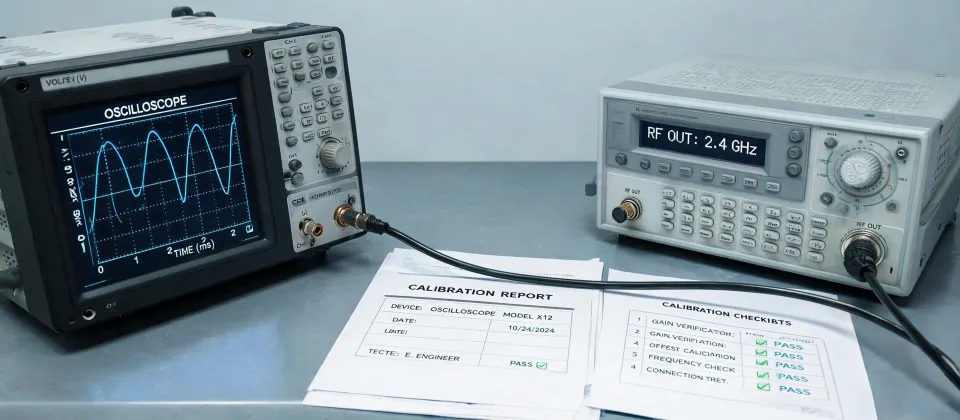
I approve test equipment before it reaches our production floor. Roughly 200 instruments a year — oscilloscopes, clamp meters, multimeters, power analyzers. Around 15% of first deliveries fail my acceptance checks. Sometimes it's a calibration issue. Sometimes a spec that doesn't measure up. And sometimes — especially with used gear — it's somewhere in between.
This article compares two routes to owning a Tektronix 4-channel oscilloscope: buying new, or buying used. I've been on both sides of that decision enough times to know the answer isn't as obvious as the price tags make it look.
The comparison runs on four dimensions: calibration confidence, true cost, verification effort, and what you're left with three years after the purchase. I'll give a clear verdict on each, then map the choice to specific scenarios at the end.
Calibration confidence: new wins, but not for the reason you think
A new 4-channel Tektronix scope — a 3 Series MDO or 4 Series B, for example — arrives with a factory calibration certificate. Current data, traceable to national standards, filed before you unbox the instrument. You're done in five minutes.
Used scopes are where "calibrated" becomes a loaded word. Here's something vendors won't tell you: it covers three very different realities.
- Actually calibrated — sent to an accredited lab, certificate with dates, standards, and uncertainty values. This is the real one.
- Ran a self-cal — the built-in routine checks internal references, but it doesn't verify external accuracy. Self-cal is fine as a routine check. It's not calibration.
- Sticker applied — no lab, no data, no traceability. It happens more than you'd expect.
People assume a newer scope is automatically more accurate. Makes sense — newer electronics, less drift, right? Actually, accuracy comes from calibration, not age. I measured a five-year-old scope that sat comfortably within spec on all four channels, and a new-in-box unit that drifted 15% on a DC offset. The difference wasn't age. It was whether anyone had actually verified the instrument.
So in this dimension, new wins — but purely because the evidence is bundled in the box. A used scope with a current certificate from an ISO 17025 accredited lab matches it. The catch is confirming the certificate belongs to the unit and isn't clipped from an old listing photo.
And on that point: per FTC guidelines, a seller who advertises a used scope as "calibrated" is making a claim that has to be substantiated. Ask for the certificate before you commit. If a seller can't produce it, that's your answer.
Verdict: new, unless you can verify the certificate.
Total cost: the sticker price isn't the number you pay
A new 4-channel Tektronix in the 3 or 4 Series range runs somewhere between $4,000 and $15,000 depending on bandwidth and options. Used units from lab liquidators and reputable dealers land at maybe 35–60% of that. Don't hold me to those ratios; pricing shifts with the market, but that's the range I've seen across roughly 30 purchase orders over the past few years.
Here's the thing: the cost gap narrows fast once you add verification.
- Calibration by an accredited lab, for a 4-channel scope: $400–700 at current rates. Maybe $300–500 for a 200 MHz model — I'd have to check the lab's price sheet.
- Failed calibration, adjustment, and re-certification: easily double the base figure.
- Your time to run acceptance tests and document results: call it half a day, if you do it properly.
Now run that math. A used scope listed at 60% of new still looks like a deal. But add $600 for calibration, a few hundred more if something doesn't pass, and the saving shrinks to maybe 20–25% — with the residual risk deducted from the savings. On a $6,000 total spend, that might still be worth it. On a $15,000 instrument, the possibility of an unexpected repair bill gets uncomfortable.
Looking back at the first used scope I approved for our main test cell, I should have checked the lab's accreditation scope before signing off. The certificate looked solid. It was, technically. But the recorded uncertainty wasn't tight enough for the measurements that station was doing. We caught it in the next internal audit, and it cost a re-verification cycle that set us back three weeks.
Verdict: used wins on price, but only if you price in verification on day one.
Performance verification: I run the same protocol on both
Whether the packaging has never been opened or the scope was pulled from an operating lab, my acceptance test is the same:
- Inject a known signal into each of the four channels and compare displayed values against the source.
- Check rated bandwidth on every channel, not just channel 1.
- Verify timebase accuracy and trigger behavior, including some edge cases.
- Measure DC offset accuracy with a calibrated source.
- Run it for 30+ minutes and watch for drift or intermittent failures.
The protocol doesn't change between new and used. What changes is the expected failure rate. In my experience, new units fail this test maybe 2% of the time. Used units from a solid source fail closer to 8–10%. That's not an argument against buying used — it's an argument for budgeting time and contingency for it.
Oh, and one thing most people don't realize: I've rejected more new-in-box Tektronix instruments sourced from unauthorized dealers than used units from maintained labs. Grey-market gear with damaged calibration certificates, mismatched serial numbers, repackaged demo units. "New" doesn't automatically mean trustworthy if the supply chain is murky.
Verdict: same protocol for both. Different expectations.
Support and longevity: the dimension with the least obvious conclusion
New scopes include a warranty, official support channels, and firmware updates arriving on a schedule. Used scopes are typically sold as-is, and if the model is a few generations old, the firmware is whatever the last owner installed. For bench work, that's usually fine. For a regulated environment, it can be a problem.
To be fair, Tektronix is genuinely good about long-term instrument support. I've seen 20-year-old TDS-series scopes still performing within spec, still recognized by current software, still holding calibration. That durability makes a used purchase far less risky than it would be with a lesser brand. Granted, it also means the resale value stays higher — so you're not getting as deep a discount as you might expect. Trade-offs both ways.
Here's the least obvious conclusion: for tolerance-tolerant work like debugging, education, or pre-compliance checks, a verified used 4-channel Tektronix is arguably the better buy, even if money isn't tight. The performance difference between a well-maintained older model and a new one rarely shows up in those tasks. But for channels of work where measurements become evidence — compliance reporting, customer deliverables, quality records — buy new. The warranty, documentation chain, and zero-question provenance are worth the premium.
Verdict: new for evidence-grade work, verified used for the rest.
Which route should you actually take?
Let me make it concrete. Three scenarios I've seen play out multiple times:
Scenario 1: your measurements feed into a quality record or regulatory submission. Buy new. The paperwork trail alone — calibration certificate, warranty, service history — is worth the price delta. In a quality audit, a clean instrument provenance chain is exactly what gets checked.
Scenario 2: you're setting up a lab bench, training area, or secondary test station on a real budget. A used Tektronix 4-channel scope from a credible source is a legitimate choice. But make the purchase conditional: a current ISO 17025 calibration certificate matching the serial number, and a documented acceptance test before final payment. Any seller who resists conditional acceptance gets a pass from me.
Scenario 3: you need measurement capability tomorrow and the budget is whatever's left in the current quarter. Take neither route. Rent or borrow, then plan the real purchase properly. Impulse-buying either a new scope you haven't fully specced or a used one you haven't verified is how you end up with an expensive box that does the job 85% as well as the one you actually needed.
The same verification discipline applies beyond oscilloscopes. Our clamp meters, our bench multimeter — even a simple electrical multimeter like the Fluke 114 we keep handy — get checked against known references on a schedule. So do the handheld field tools; the Extech moisture meter we use for facility inspections gets a two-point verification before every audit month. It's routine, it takes minutes, and it's caught real problems before they reached a customer.
What most people don't realize about test equipment, new or used, is that the purchase is just the first step. The verification routine is what actually protects your budget, your data, and your reputation. It doesn't care whether the box was sealed six months ago or pulled from a lab bench after six years. It cares whether the instrument performs to spec. Make that part of your process, and either route can work. Skip it, and both can hurt you.
Marcus Feld
Marcus Feld is an electrical test and measurement analyst specializing in multimeters, oscilloscopes, clamp meters, insulation testers, spectrum analyzers, and data loggers. He applies IEC 61010-2-030 and IEC 61010-031 concepts while examining measurement category, bandwidth, true-RMS response, input loading, and stated uncertainty. His work helps maintenance engineers and test teams choose safe instruments with performance suited to the signals and environments they actually measure.
Leave a technical comment