The Real Cost of Buying a Tektronix Oscilloscope Without the Right Question
Posted on 2026-08-03 by Marcus Feld
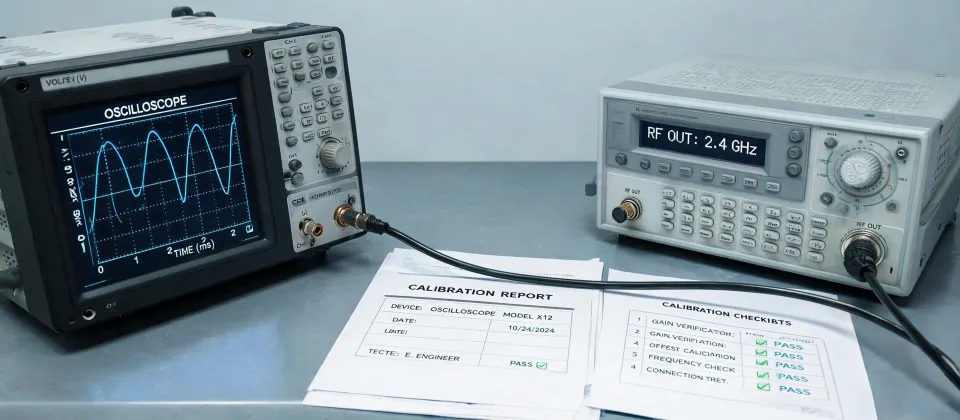
The request sounded simple. The problem wasn't.
Can you order a Tektronix oscilloscope 100 MHz? That was the entire request. No context. Just a brand, a bandwidth, and a job number.
I'm the office administrator for a 200-person R&D and QC engineering firm. I manage roughly $300,000 in test equipment purchases a year, across 12 vendors. My job is to make sure the right things get ordered without throwing money away. So I placed the order.
The engineer came back two weeks later and said it didn't work. The scope was fine. The problem was the request.
I only fully believed in asking why after that. You'd think one expensive mistake would be enough.
Why a model number is not a requirement
That 100 MHz scope ended up being reassigned to another team. The engineer who requested it actually needed to catch a glitch that appeared once every fourteen minutes on a power rail. An old analog scope couldn't store that event. But he had asked for a Tektronix 2465B oscilloscope because a forum said it was the best analog scope ever made. It wasn't a terrible instrument. It was a wrong choice for that problem.
I found one, placed a used-equipment order, and then waited for calibration. When the engineer tried to capture the intermittent glitch, the scope's screen showed only the signal he already knew about. Then the invoice arrived. Ouch.
Looking back, I should have asked what he was going to measure before buying anything. At the time, I thought a brand name and a bandwidth were enough. They aren't.
Let me rephrase that: the request was a 100 MHz scope. What I should have heard was 'I need to see a signal that happens in microseconds and repeats every few minutes.' Those are two very different sentences.
For a one-shot glitch, a scope's sample rate and memory depth matter more than the number printed under the brand. For catching glitches: sample rate, memory depth, trigger. In that order.
Then came the arm CMM request.
The arm CMM that almost happened
An engineer from quality asked for an arm CMM to inspect a new batch of castings. The quote came back at $38,000. When I asked what specifically needed to be measured, the answer was one dimension: the distance from a bracket to a hole. We already had an optical distance sensor on the shelf that could do the same pass/fail check with a small fixture. The fixture took three days to build and cost $200.
We didn't need to measure the whole part. We needed to check one distance.
It's tempting to think that 'arm CMM' is a requirement. It's really a possible solution to a question we hadn't asked.
When 'how to use a Fluke multimeter' is the wrong search
Another month, a maintenance technician told me his multimeter readings didn't make sense and he needed a better meter. It happened to be a Fluke. I typed 'how to use a Fluke multimeter' into a search engine and found the manual. The answer was on page 12: his test leads were plugged into the wrong jacks. No meter purchase happened. I felt equal parts relieved and ridiculous.
Here's the thing: when someone asks for a tool by name or model, they haven't yet separated the problem from the object. That's not a criticism of engineers. It's a natural way to think. But it's a dangerous way to spend capital.
The cost of buying for the wrong question
Let me add up the 2465B lesson. The used scope: $450. Calibration and certification: $385. Engineer time trying to catch a glitch that analog couldn't store: roughly a week. We finally captured it with a borrowed digital scope in 45 minutes. The 100 MHz Tektronix we originally bought now sits on the bench and gets used about three times a month. It was the right tool for the team, just not for that request.
The arm CMM quote was $38,000. The fixture with the optical distance sensor cost $200 and three days. The castings were certified inside a week. I'm not saying arm CMMs are overrated. We're actually buying one next year for a different project, once we've documented what it will measure. That purchase will be driven by a requirement, not a recommendation.
These are not catastrophic failures. They're slow leaks. Rework, idle tools, and confused staff add up faster than most people admit.
A checklist that costs five minutes, not five days
The fix wasn't a new purchasing system. It was a paper checklist taped to my monitor. I ask five questions before any test equipment request:
- What are you trying to measure? Not what instrument you need.
- Is it a one-time debug or a recurring check?
- Where will it be used: bench, field, cleanroom?
- Do you need to record the result, or just see it?
- What happens if the measurement is wrong?
If the answer is 'we need to catch a rare glitch,' a 100 MHz digital scope with deep memory is a different purchase than a Tektronix 2465B. If the answer is 'we need to check one distance on a casting,' an optical distance sensor might be a better starting point than an arm CMM. If the answer is 'the readings don't look right,' send the manual first.
Five minutes of verification beats five days of correction. That checklist, in the two years since I put it up, has saved us an estimated $80,000 in avoided idle equipment and rework. The savings came from questions, not frugality.
(Should mention: the checklist doesn't stop every mistake. It just makes the mistakes smaller.)
If the measurement has to go into a customer report, it also needs calibration traceability. We use ISO/IEC 17025-accredited labs for that. That's another reason to ask the why before buying: a $200 fixture might be fine for an internal go/no-go, but a certified measurement needs a certified instrument.
The better question
I'm not against brand names. We buy Tektronix scopes and Fluke meters because they have support, calibration paths, and long reliability tails. But a brand name is part of the answer, not the question.
When someone asks for a 100 MHz scope, I now ask what they're going to see. When a vendor suggests an arm CMM, I ask what tolerance matters. When a maintenance tech says the multimeter isn't working, I ask how he's using it. The purchase is the easy part.
Look, I still make bad calls. But I no longer buy a tool for a problem someone hasn't described. That has saved more money than every discount code I've ever used. At least, that's been my experience with a 200-person engineering team.

Marcus Feld
Marcus Feld is an electrical test and measurement analyst specializing in multimeters, oscilloscopes, clamp meters, insulation testers, spectrum analyzers, and data loggers. He applies IEC 61010-2-030 and IEC 61010-031 concepts while examining measurement category, bandwidth, true-RMS response, input loading, and stated uncertainty. His work helps maintenance engineers and test teams choose safe instruments with performance suited to the signals and environments they actually measure.
Leave a technical comment