The $22,000 Timeout: How We Learned to Test Our Test Equipment
Posted on 2026-07-27 by Marcus Feld
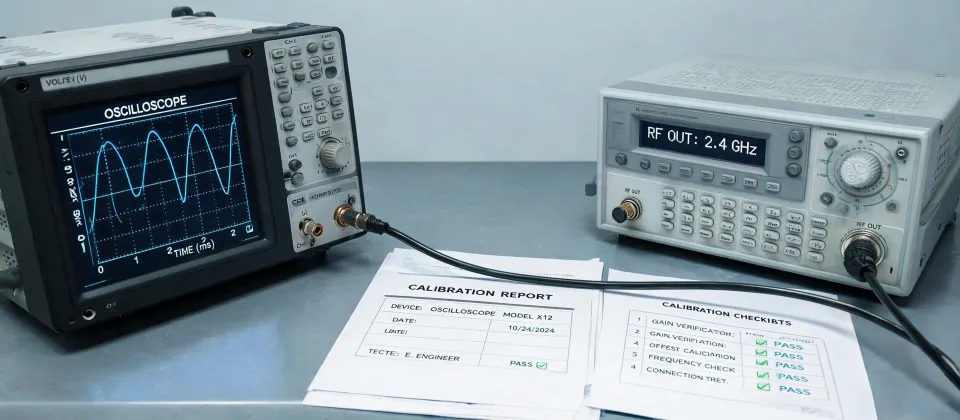
It was a Tuesday in March 2023. I was staring at a waveform on a Tektronix 4-Series MSO that looked… wrong. Not obviously wrong—the kind of wrong you feel before you can prove. A 0.3% variance in the rise time measurement against our reference standard. Well within the published spec. But something in my gut said this was gonna be a problem.
I ignored it for a week. Told myself it was just the probe compensation. That I was being paranoid. That we'd paid a premium for Tektronix gear, and premium gear doesn't just drift.
I was wrong on all counts.
The Setup: Why We Bought Tektronix in the First Place
Back in 2021, our lab made the switch. We were running a mix of older Rigol and Siglent scopes, and we needed better noise floor performance for a new sensor development project—a hydrostatic level sensor that required sub-mV accuracy at high sample rates. The Tektronix real-time spectrum analyzer (an RSA500 series) and a 5-Series MSO were the big-ticket items. Roughly $48,000 for the pair (as of Q3 2021 pricing).
The decision wasn't hard. When you're dealing with signals that small, you don't mess around with entry-level gear. I knew that. My team knew that. And for the first year, everything was fine.
The Research Pipette Lesson I Should Have Already Learned
See, I came from a different world before this—medical device quality. In that world, you don't just assume a research pipette dispenses the right volume because it says 'Eppendorf' on the side. You calibrate it. Every 90 days. You log it. You keep a paper trail that could survive a fire.
But when I moved to industrial instrumentation, I let the brand name do the heavy lifting. It's a dumb mistake, and I'm embarrassed to admit it took a Tektronix oscilloscope software update to finally wake me up.
The Trigger: A Flaky Firmware Update
In late 2022, Tektronix released a significant software update for the 4/5/6-Series instruments. We applied it across our fleet—seven scopes total. After the update, one of the engineers on the sensor project came to me with a complaint: the automatic measurement on channel 2 of our 5-Series was reading 1.8% high on a known DC reference.
I ran through the usual troubleshooting: probe compensation, input impedance settings, grounding. Nothing fixed it. Then I swapped in a different Tektronix probe (a TPP1000), and the reading shifted again—to 1.2% high. Same scope, different probe, different error.
That's when I knew we had a probe compatibility issue, not a scope issue. But it also made me realize: we had no baseline. We couldn't say definitively whether the scope was accurate, because we hadn't verified it against a known standard since the day it arrived.
The Moment It All Fell Apart
The real disaster came three weeks later. We shipped a batch of 50 prototype sensor units to a client based on measurements taken from that scope. The client tested them with a Fluke 117 True RMS multimeter (the same one I'd used in the field for years) and found a consistent 2.4% deviation in output voltage across the entire batch.
They rejected the lot. All 50 units. Net cost: $22,000 for the redo, plus a two-month delay to our product launch. For a small R&D department like ours, that was a significant chunk of our annual budget.
I remember the conversation with my director like it was yesterday. He said: "I thought we bought Tektronix because they were the gold standard?" And I had to admit: the brand was fine. Our process was the problem.
The Fix: Building a Verification Protocol
In Q1 2023, I implemented a verification protocol for every piece of test equipment in the lab. Here's what that looks like in practice:
- Baseline measurement: Every new instrument gets tested against a calibrated reference before being put into service. For oscilloscopes, that means a known DC source and a precision function generator (we use a Keysight 33600A for this, but honestly, any generator with better specs than your scopes works).
- Quarterly checks: Every three months, we spot-check each scope's vertical and horizontal accuracy. Takes about 30 minutes per instrument.
- Post-update verification: Any firmware update triggers a full re-verification, not just a spot check.
- Logged results: Everything goes into a shared spreadsheet with dates, results, and technician initials. Sounds basic, but it saves your ass when a client asks for records.
Since we implemented this, we've caught two more drift events—one in a Tektronix MSO (channel 3 gain was off by 0.7%) and one in an older Agilent DSO we use for backup. Neither caused a recall because we caught them before anything shipped.
What This Means for the Tektronix Oscilloscope Software
The software itself is fine—Tektronix's oscilloscope software platform is stable and well-supported. The issue was that we treated it as a black box. We assumed that because the software ran without errors, the hardware behind it was perfectly calibrated. That's a dangerous assumption with any instrument, at any price point.
The Honest Take: When to Still Buy Tektronix
I still recommend Tektronix gear for specific situations—and I'm honest about where it doesn't fit. If you're doing high-speed serial data analysis, or you need deep memory for long captures on power rails, the 5-Series and 6-Series are excellent choices. Their real-time spectrum analyzers (the RSA line) are genuinely class-leading for mid-range RF work, and the software ecosystem (TekScope, etc.) is mature.
But if you're doing one-off repair work on guitar amplifiers, or teaching basic electronics to undergraduates, you don't need a $15,000 Tektronix MSO. A Rigol DS1102Z or a Siglent SDS1104X will do the job with 95% of the capability at 15% of the price. And honestly? That extra 5% doesn't matter if you don't have a verification protocol in place anyway.
"The brand profile is only as good as the maintenance schedule. I've seen Keysight gear drift faster than Tektronix gear, and vice versa. The common factor in all failures is the user who assumed it wouldn't happen to them."
The Bottom Line
That $22,000 mistake taught me something I wish I'd learned earlier: trust the instrument, verify the measurement. It doesn't matter if you're using a Tektronix real-time spectrum analyzer or a Fluke 117 True RMS multimeter—if you don't know your baseline accuracy, you're guessing. And in this industry, guessing costs you time, money, and reputation.
As of January 2025, we run verification on roughly 200 unique test items annually—oscilloscopes, probes, function generators, multimeters, and even the research pipettes we use in our lab for small-volume fluid measurements. The process takes maybe 20 hours of technician time per quarter. Against the risk of another $22,000 batch rejection? It's a no-brainer.
The best piece of test equipment is the one you've verified. Everything after that is just a feature list.
Marcus Feld
Marcus Feld is an electrical test and measurement analyst specializing in multimeters, oscilloscopes, clamp meters, insulation testers, spectrum analyzers, and data loggers. He applies IEC 61010-2-030 and IEC 61010-031 concepts while examining measurement category, bandwidth, true-RMS response, input loading, and stated uncertainty. His work helps maintenance engineers and test teams choose safe instruments with performance suited to the signals and environments they actually measure.
Leave a technical comment