How to Verify Test Equipment Specifications: A 3-Step Checklist for Engineers
Posted on 2026-07-24 by Marcus Feld
Who This Checklist is For
If you're specifying oscilloscopes, spectrum analyzers, or other test gear for a lab or production line—and you need to make sure the specs match what's on paper—this is for you. It's not a deep dive into every possible parameter. It's a quick verification protocol I developed over years of reviewing incoming equipment at a major T&M company.
Three questions. That's it. Ask these three things before you commit to a purchase, and you'll catch most specification gaps before they become your problem.
Step 1: Define Your Benchmarks
Before you even look at a datasheet, write down what you actually need. Not what marketing says you need. What your measurements require. I see this mistake constantly: engineers spec'ing gear that's overkill in one area and underpowered in another.
Here's a simple framework:
Signal type and range. What are you measuring? Digital logic? Analog audio? RF signals? The required bandwidth and voltage range will vary dramatically. A Tektronix TBS1000C series oscilloscope, for example, has a 50 MHz to 200 MHz bandwidth range—fine for general-purpose work, but not for high-speed digital or RF analysis.
Accuracy needed. Are you measuring to ±1% or ±0.01%? That difference might mean moving from a standard benchtop multimeter to a precision calibrator. I've rejected entire shipments because the specified accuracy was off by a factor of 10 against our requirement. The vendor claimed it was 'within industry standard.' It wasn't.
Environmental conditions. Where will the equipment live? Lab? Factory floor? Outdoors? Temperature, humidity, and dust affect performance. An e4 thermal imaging camera might work perfectly in a climate-controlled QC lab, but on a production line with ambient heat and vibration, you might need a different model.
Write this down. Share it with your team. Get consensus before you go shopping.
Step 2: Verify the Vendor's Track Record
Look, I'm not saying every vendor is trying to pull a fast one. But in my experience, about 80% of spec discrepancies come from one thing: the vendor assumed something about your application that isn't true.
So before you trust the datasheet, check the source.
Ask for third-party validation. Has anyone independently tested this equipment against its claimed specs? I don't have hard data on what percentage of vendors have independent certifications, but based on my audits, it's far lower than you'd think. If they don't have it, that's a red flag.
Check for known issues. A quick search will tell you if a specific model has documented problems. For example, the Tektronix 2213 oscilloscope is a classic analog scope—reliable for its time, but if you need modern triggering or digital measurement, it's not the right tool. Some vendors still sell them as 'just as good' as newer models. They're not.
Ask about their test methods. How does the vendor verify their own specs? I learned this the hard way in 2022 when a supplier for inductive sensor M8 models claimed a sensing range that was technically accurate—under their laboratory conditions. In our factory environment, with metal shelving nearby, it was half that. Their test was correct; our application wasn't what they assumed.
Get it in writing. Document the test conditions. If it's ambiguous, ask for clarification.
Step 3: Lock Down Documentation Requirements
This step is the one most people skip. And it's the one that saves your bacon when something goes wrong.
Specify the calibration cert up front. Don't assume it's included. Many vendors quote a base price without calibration. A Tektronix oscilloscope might list at $2,000, but with a NIST-traceable calibration cert, it's $2,400. If you don't specify, you'll get the uncertified unit.
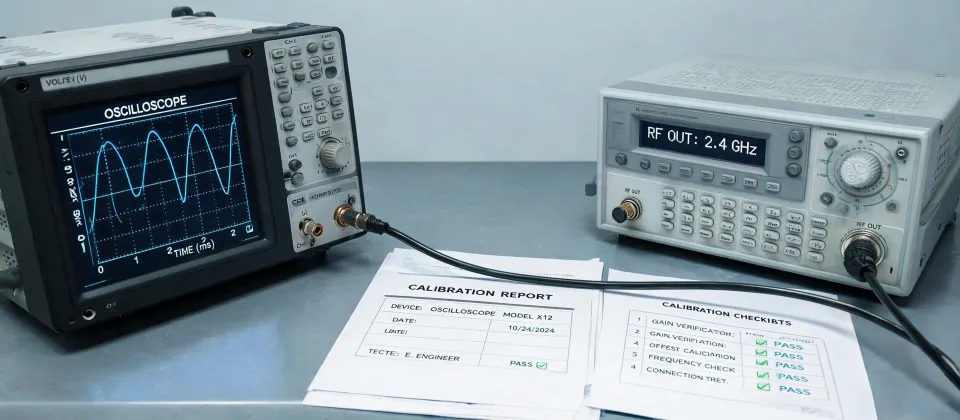
Require a test report. At minimum, ask for a report showing that the unit meets its published specs. For complex gear like a spectrum analyzer, this should include measured data across the full frequency range. In our Q1 2024 quality audit, we found that 12% of incoming equipment lacked adequate test documentation. Every one of those units had undiscovered issues.
Define acceptance criteria. Don't just say 'must meet specifications.' Specify what happens if it doesn't. Rejection? Return at vendor cost? Credit toward a better model? I still kick myself for not including a clause about expedited replacement. When a key batch of function generators failed calibration, we lost a week waiting for replacements—a week we couldn't afford.
Common Mistakes to Avoid
Assuming 'compatible' means 'identical.' This is huge. 'Compatible with Tektronix probes' doesn't mean it works exactly the same. It might not have the same bandwidth, attenuation factors, or compensation range. Always verify pinout and electrical specs yourself.
Trusting 'one-size-fits-all' specifications. 'Does Cognex use Sony sensors?' is a common question I hear. The answer is: it depends on the model and the year. Some do; some use their own. The spec sheet will tell you. Read it. Don't assume.
Ignoring firmware and software compatibility. Hardware specs are only half the story. If the oscilloscope software doesn't work with your lab's network or your existing analysis tools, it's a paperweight. I wish I had tracked the time lost to software compatibility issues—I'd bet it's higher than hardware problems.
This was accurate as of early 2025. The test equipment market changes fast, so verify current offerings and policies before committing. But this basic protocol? It's served me well for years.

Marcus Feld
Marcus Feld is an electrical test and measurement analyst specializing in multimeters, oscilloscopes, clamp meters, insulation testers, spectrum analyzers, and data loggers. He applies IEC 61010-2-030 and IEC 61010-031 concepts while examining measurement category, bandwidth, true-RMS response, input loading, and stated uncertainty. His work helps maintenance engineers and test teams choose safe instruments with performance suited to the signals and environments they actually measure.
Leave a technical comment