Tektronix and Beyond: A 7-Step Test Equipment Buying Checklist
Posted on 2026-08-20 by Marcus Feld
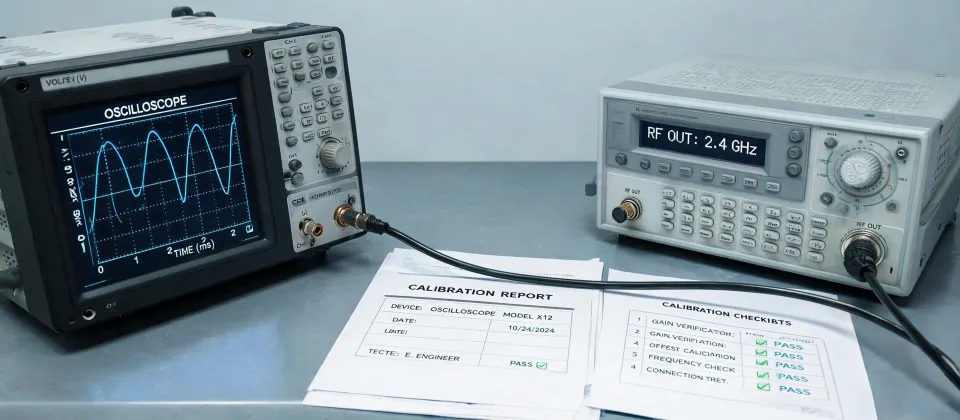
-
Step 1: Confirm the Use Case Before You Search for Prices
-
Step 2: For Oscilloscopes, Channel Count Is the First Spec
-
Step 3: Decide Whether Vintage Makes Sense (Usually It Does Not)
-
Step 4: Buy Each Equipment Category From Its Specialist
-
Step 5: Verify Calibration, Paperwork, and Invoicing Before Purchase
-
Step 6: Count the Total Cost of Ownership
-
Step 7: Run This Sourcing Checklist on Every PO
- Common Mistakes I Still See (and Have Made)
I'm the office administrator for a mid-sized R&D firm—about 120 people across two buildings. I manage all lab equipment orders: oscilloscopes, probes, calibration renewals, pipettes, and measurement tools. That's roughly $300,000 per year across 20-odd vendors. Maybe $280,000; I'd have to pull the procurement report. Five years of doing this taught me one lesson: getting the spec wrong costs more than the equipment itself.
This checklist is for anyone who has to order test equipment without being a test engineer. It has 7 steps. Follow them in order, and you'll avoid the mistakes that create rework, upset engineers, and blow budgets.
Step 1: Confirm the Use Case Before You Search for Prices
The most common mix-up in our lab requests is megger vs multimeter. Both measure electrical properties. Neither substitutes for the other. A multimeter reads voltage, current, and resistance—perfect for continuity checks and board troubleshooting. A megohmmeter, often called a "megger," applies a controlled high DC voltage (250V, 500V, or 1000V, depending on the model) and measures the resistance of cable insulation or motor windings.
If the requisition says "insulation test," that's a megger. If it says "checking why this board isn't powering up," that's a multimeter. Ask the requester, out loud, what they're going to do with it. This one question has saved me from buying the wrong tool at least four times.
Checkpoint: every requisition should state the application, not just a part number.
Step 2: For Oscilloscopes, Channel Count Is the First Spec
When engineers say "oscilloscope," they usually mean Tektronix. The company has been making scopes since the late 1940s, and its triggered-sweep breakthrough basically defined the modern scope. Just as important for procurement: Tektronix offers genuinely useful educational resources—fundamentals primers, application notes, and support documentation. That ecosystem saves our engineers time, and it's a big part of why we're a Tektronix shop.
But "a Tektronix" is not a spec. The first question is channel count. Most general-purpose electronics work—repair, validation, basic signal debugging—only needs 4 channels. Power electronics design, like debugging a three-phase inverter while watching control signals, needs more simultaneous views. That's the role of a Tektronix 8 channel oscilloscope (the 5 Series MSO family, for instance): all phases and the control bus on one display, with a shared timebase and synchronized triggering.
I've seen two failure modes here. One is buying an 8-channel scope for a repair bench that only ever uses two probes—that wastes budget which could have covered two benches with 4-channel scopes. The other is buying a 4-channel for a team that's about to start a motor-drive project; they'll hit the ceiling in six months and you'll be reordering.
Ask what projects the scope will support for the next 18 to 24 months. Not just the part number—the project.
Step 3: Decide Whether Vintage Makes Sense (Usually It Does Not)
There's a genuine market for Tektronix oscilloscope vintage units. Classic models like the Tektronix 465 analog scope from the 1970s appear on auction sites for a few hundred dollars. When our training lab needed extra scopes for a circuit-analysis class, that price looked tempting.
Here's what I learned: this was true 20 years ago, when a new 4-channel scope cost $15,000 and a used one at $800 made sense on a shoestring budget. Today, entry-level modern scopes—even in the affordable end of Tektronix's lineup—offer more bandwidth, more memory, and triggering that vintage analog can't approach, for roughly $1,000 to $4,000 new as of early 2025 (verify current pricing at tektronix.com), with a warranty and calibration certificate included.
The failure mode, specifically, is calibration. A 1980s scope with its original factory calibration might be accurate within a few percent on a good day, but "might be" is not a specification. Our lab does compliance-related measurements. An auditor would not accept "we trust the 45-year-old scope" as a calibration record.
Where vintage still works: teaching benches that focus on analog circuit concepts, or hobby benches where absolute accuracy isn't the point. If you go that route, budget for professional calibration and a fan/PSU refurbishment. Factor in two to four weeks of lead time. And confirm that documentation for the model is still available; Tektronix's support archive covers many legacy instruments.
Step 4: Buy Each Equipment Category From Its Specialist
This step took me years to learn. No single vendor is the right source for a Tektronix oscilloscope, a multi channel pipette, and a dial indicator with magnetic base. A vendor who claims to be a one-stop shop for all three is reselling at least two of them without the technical depth to support them.
The vendor who told me, "This isn't our strength—here's who does it better," earned my trust for everything else we buy from them. Specialists who know their limits are easier to work with than generalists who overpromise. That's why I order scopes from Tektronix, pipettes from a lab-consumables specialist, and dial indicators from a metrology house.
A specialist's value shows up in the details. Tektronix's oscilloscope education materials, for instance, don't just say "buy this." They explain how measurements work, which probe to use for a differential signal, and why grounding matters. A general reseller listing a thousand unrelated items can't provide that. And if a vendor tells you they handle absolutely everything, ask yourself which category they actually know well.
Step 5: Verify Calibration, Paperwork, and Invoicing Before Purchase
When I took over purchasing in 2020, I found a great price from a new vendor and ordered a batch of instruments. They delivered on time. (Should mention: we'd built in a 3-day buffer after a prior late shipment from another supplier.) But their only proof of purchase was a handwritten receipt. Finance rejected the expense report. I ended up covering $2,400 from the department budget while procurement sorted out the vendor's paperwork. Now I verify invoicing capability before placing any first order.
For test equipment, calibration documentation matters even more. Ask for the calibration certificate as part of the quote, and check three things:
- The calibration date—it should be within the last 12 months
- The stated accuracy under the listed test conditions
- The traceability standard, ideally ISO/IEC 17025
Looking back, I should have specified calibration requirements in the purchase order from the start. At the time, I assumed every new instrument came with a current certificate. Usually it does—until you get the floor demo that nobody recertified. That happened to us once with a Tektronix scope that arrived with an 18-month-old calibration date. The engineer caught it before relying on any measurements, and the vendor replaced it. The rework time, though, was on us.
Step 6: Count the Total Cost of Ownership
The quoted price on an instrument is never the final number. Hidden costs add up fast (think probes, calibration renewals, spare accessories, shipping). For an oscilloscope, you'll want at least one spare probe set. For a multi channel pipette, the tips are the recurring cost—confirm the model uses tips that your lab supply vendor actually stocks, and budget for regular pipette calibration depending on usage.
For a dial indicator with magnetic base, the base is not an afterthought. It's what holds your measurement stable. Look for a holding force of at least 300 N (a reasonable benchmark as of early 2025), a fine-adjustment knob for positioning, and an arm that reaches the typical setups your team uses. A cheap base with a weak magnetic grip sags mid-measurement, the indicator drifts, and your machinist gets readings that don't repeat. That's not saving money; that's buying scrap.
The cost formula we use:
- Base price
- Calibration and recertification costs
- Accessories and consumables (probes, tips, replacement batteries)
- Shipping, expediting, and customs fees
- The cost of rework when the spec was wrong
Step 7: Run This Sourcing Checklist on Every PO
Since our 2024 vendor consolidation project, this is the final check before I hit submit:
- Confirmed the application with the requester—verbally, not just on the form
- Channel count, resolution, or range matches the application for the next 18–24 months
- Vendor is a recognized specialist in that equipment category
- Calibration certificate is current, traceable, and included in the quote
- Invoice can be processed by finance (no handwritten receipts)
- Spare parts and consumables are available and priced
- Lead time fits the requester's schedule, plus buffer
Common Mistakes I Still See (and Have Made)
Megger vs Multimeter Mix-Up
A multimeter checks continuity and basic voltage. A megger tests insulation resistance under high voltage. If the requester says "insulation" or "winding test," it's a megger. If they say "trace why this board is dead," it's a multimeter. Not interchangeable.
Buying More Oscilloscope Than the Work Needs
A Tektronix 8 channel oscilloscope is a serious investment. It's the right tool for power electronics and mixed-signal work. But a general repair bench will live fine with a 4-channel scope, and over-specing eats budget that could equip a second bench.
Vintage Without a Calibration Plan
Vintage Tektronix oscilloscope units make charming teaching aids and hobby instruments. Using them for compliance measurements without full recalibration is not charming—it's an audit finding waiting to happen.
Skipping the Magnetic Base Spec
A dial indicator with magnetic base is only as good as its base's holding force. If the indicator drifts, the measurement means nothing. Verify the base spec before you order, not after the machinist complains.
Forgetting the Consumables
A multi channel pipette is nothing without compatible tips. An oscilloscope is nothing without probes. Order spares at the same time. The internal client will remember you as the person who got it right.
One rule I hold to: if it has to be right the first time, buy from the specialist. A vendor that admits its limits is a vendor you can trust with the orders that matter.
That's the checklist. It's not glamorous, but it's the difference between an equipment budget that works and one that leaks. If you're new to this side of the job, start with Step 1 on your next PO. It's the step that prevents the most rework.

Marcus Feld
Marcus Feld is an electrical test and measurement analyst specializing in multimeters, oscilloscopes, clamp meters, insulation testers, spectrum analyzers, and data loggers. He applies IEC 61010-2-030 and IEC 61010-031 concepts while examining measurement category, bandwidth, true-RMS response, input loading, and stated uncertainty. His work helps maintenance engineers and test teams choose safe instruments with performance suited to the signals and environments they actually measure.
Leave a technical comment