Choosing Test & Measurement Equipment: It Depends on Your Situation
Posted on 2026-08-21 by Marcus Feld
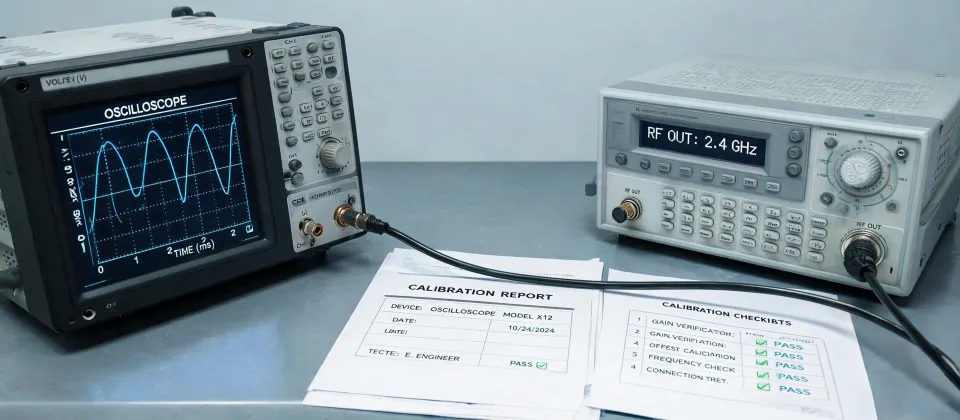
People assume that as the office administrator for a mid-sized engineering firm, I just look for the best price on test and measurement equipment. Not quite. After five years of managing lab and industrial purchases—roughly $120,000 a year across 15 vendors—I've learned that "best" depends entirely on the situation. Sometimes the right answer is a $6,000 oscilloscope. Sometimes it's a free PDF. Not ideal if you want a simple rule, but workable.
Here's the framework I use when a requisition lands on my desk: match the tool to the actual work. That sounds obvious, but you'd be surprised how many purchases happen because someone skimmed a product brochure and decided it looked useful.
In my experience, most requests fall into one of four situations:
- R&D / embedded development — engineers debugging circuits that mix analog and digital signals.
- Maintenance / electrical repair — technicians who need safe, reliable measurement tools.
- Manufacturing QC / facilities inspection — checking products and equipment with vision sensors or thermal cameras.
- Training / team growth — getting new engineers up to speed without burning the budget.
Let me walk through each one and what I'd actually buy.
Scenario 1: R&D Engineers Debugging Mixed-Signal Circuits
This is the classic "we need an oscilloscope" request. But if your engineers work on embedded systems—say, a microcontroller communicating with sensors over I2C or SPI—a standard scope isn't always enough. They need to see analog waveforms and digital logic at the same time. That's what a tektronix mixed signal oscilloscope does well.
We bought a Tektronix MSO in 2022, and it finally ended a week-long debugging nightmare. Our senior engineer was chasing a glitch that only appeared when a PWM signal overlapped with a CAN bus transmission. On a regular scope, he was pretty much guessing. On the MSO, he could view both domains simultaneously and isolate the problem in an afternoon.
Before you ask: yes, a four-channel MSO with logic analysis capability costs more than a basic scope. Is it worth it? In my opinion, absolutely—if your team regularly designs or troubleshoots embedded hardware. The speed at which engineers can move from "something weird is happening" to "here's the exact fault" directly affects how fast your product ships. That's not a cost center, that's a competitive advantage. (For specs and application details, Tektronix's site is genuinely useful—tektronix.com has comparison charts that don't require a login.)
Scenario 2: Maintenance Teams and Multimeter Repair
Here's the take that gets me funny looks from procurement colleagues: don't buy the cheapest multimeter.
I understand the instinct. A maintenance supervisor asks for five multimeters, the budget-minded buyer picks the $20 special, and everyone moves on. That's a mistake. Some budget meters are serviceable for low-voltage bench work, sure. But your technicians might be measuring 480-volt panels. Safety ratings exist for a reason.
When I look at multimeters, I check for CAT III or CAT IV ratings per IEC 61010-1. A meter that isn't rated for the energy level it's exposed to can fail violently—not something I'm willing to risk with my team's hands on the line. "It's been fine so far" is a terrible safety strategy.
On multimeter repair: if you already own a quality unit that broke, repair is often the smarter move. We sent a well-known brand's meter to an authorized service center last year after it got dropped. Replacement cost: $180. Repair: $70. For a $20 meter, don't bother—just replace it. The math only works when the base quality is there.
What I mean by all this is that the "cheapest" option isn't just about the sticker price. It's the total cost: your time managing failures, the risk of bad readings that send techs chasing phantom faults, and the potential safety liability. I learned that the hard way. When I took over purchasing in 2020, I bought several budget meters to save maybe $40 total. Every single one read fine on the bench, but they felt flimsy and the accuracy specs were borderline. Not ideal for a team working on live equipment. We replaced them within a year.
Scenario 3: Vision Sensors and Thermal Cameras for QC and Inspections
This is where the buying decision changes completely. You're not looking at oscilloscopes anymore. You need vision sensors for production-line quality control, or a thermal camera for electrical and facility inspections.
Vision sensors are one of those purchases where quality directly determines whether the product actually solves anything. A vision sensor that misses defects or triggers false rejects is worse than no sensor at all—your team loses confidence, and line operators start ignoring it. We deployed vision sensors on a packaging line in 2023, and the reject rate dropped by about half. That saved us real money, but it also protected our brand by keeping defective product from reaching customers. In my experience, that's the part finance doesn't always see.
For thermal cameras, the question I hear most is where to buy FLIR thermal cameras. My answer: from an authorized distributor. Not from a marketplace listing that's 30% cheaper because the seller "has connections." I considered a gray-market unit once. The upside was saving roughly $2,500. The risk was no official warranty, no calibration certificate, and no real support if the detector had issues. I kept asking myself: is $2,500 worth potentially getting a camera that misreads a circuit breaker? No. The authorized unit cost a bit more, but it came with proper documentation and FLIR's support behind it.
So glad I made that call. I was one click away from ordering from an unverified reseller—a vendor who couldn't even provide a proper invoice, which would have gotten the expense rejected by finance anyway. Dodged a bullet there. If you're buying safety-critical inspection tools, the paperwork is part of the product.
It's better to over-specify a safety tool than to explain an accident on an incident report.
FLIR's own guidance (flir.com) points the same direction: buy from authorized channels to keep the warranty and calibration valid. That's worth more than the discount.
Scenario 4: Training New Engineers with the Right Resources
This one is counter-intuitive, and I stand by it: sometimes the best investment is zero dollars.
When we hired three junior engineers last year, I didn't rush to buy three brand-new oscilloscopes. Instead, I pointed them to Tektronix's "XYZs of Oscilloscopes" PDF. It covers the fundamentals—triggering, bandwidth, coupling, probing—in a way that's practical rather than theoretical. It's free, and it's been a standard reference for engineers for ages. You can find it by searching "tektronix xyzs of oscilloscopes pdf"; it's one of Tektronix's most popular downloads.
The results surprised me. The juniors ramped up faster because they understood basic measurement theory before they touched the hardware. Fewer accidental button presses, fewer "is this reading even right?" questions, less risk of damaging a $4,000 probe because someone didn't understand input impedance. In my book, that's a better return than any accessory bundle.
Does every team need this? Probably not. If you have experienced engineers, hand them a scope and they'll be fine. But for new hires, interns, or cross-training programs, make education the first line item. You can always add hardware later.
How to Tell Which Situation You're In
So which of these applies to you? Here's how I sort through vague requests when they hit my desk:
- What does the team do daily? Design or debug embedded systems → lean toward a tektronix mixed signal oscilloscope. Maintain electrical systems → prioritize safety-rated meters. Run production quality checks → look at vision sensors. Inspect facilities → thermal imaging. Build a new team → start with training materials.
- What happens if the tool fails? If failure means an electrical shock, a missed defect, or a production shutdown, quality is non-negotiable. If it means a minor inconvenience, you can be more budget-conscious.
- Who is the actual user? A senior engineer can adapt to limitations. A new technician might not even know what to be careful of. Buy for the least experienced person who will touch it.
Most companies end up in more than one category. That's fine—just be clear about which one matters most right now. In our 2024 vendor consolidation project, I learned that we didn't need to buy from ten suppliers for ten different things. We could work with a smaller set of authorized distributors who understood our mix of R&D, maintenance, and inspection needs. That cut our ordering time considerably and eliminated the recurring problem of incomplete documentation.
One last thought. If you're the person managing these purchases, you're not just buying gear—you're buying the standards your company works to. The tools you provide shape the quality of the measurements, the safety of the team, and, eventually, how your clients perceive your work. I'd rather explain to finance why we spent more than explain to an engineer why their data looks wrong. Quality in, quality out. That's the rule I buy by.

Marcus Feld
Marcus Feld is an electrical test and measurement analyst specializing in multimeters, oscilloscopes, clamp meters, insulation testers, spectrum analyzers, and data loggers. He applies IEC 61010-2-030 and IEC 61010-031 concepts while examining measurement category, bandwidth, true-RMS response, input loading, and stated uncertainty. His work helps maintenance engineers and test teams choose safe instruments with performance suited to the signals and environments they actually measure.
Leave a technical comment