Why I Stopped Buying the Cheapest Test Equipment (and Started Looking at Total Cost)
Posted on 2026-07-21 by Marcus Feld
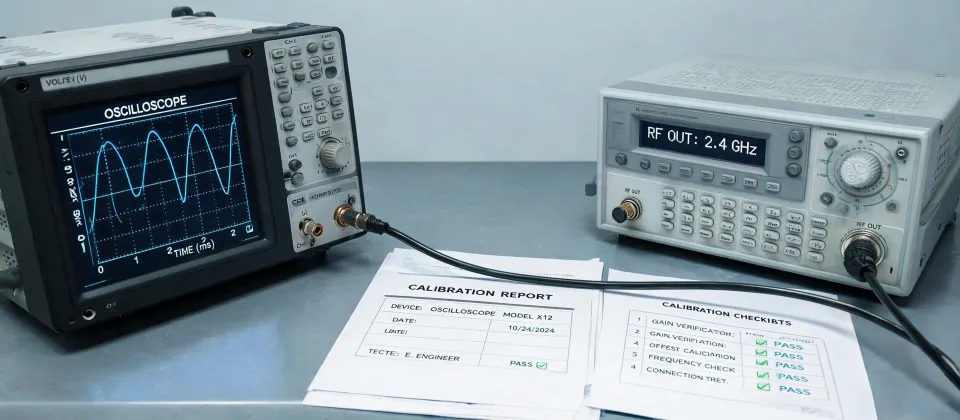
I think the "cheapest option" mindset is costing your company way more than you realize.
Let me just put this out there: I'm not an engineer. I'm the person who actually buys the stuff the engineers use. Office administrator for a mid-size R&D company — 180 people, mostly in the lab. I manage all our test & measurement ordering, roughly $180,000 annually across a dozen vendors. And after five years of doing this, I'm convinced that most procurement advice around "getting the best price" is, honestly, kind of misguided.
We buy a ton of stuff: oscilloscopes — like the Tektronix 4 series and those MSO models — spectrum analyzers, function generators, multimeters, data loggers, even random things like temperature and humidity sensors for our environmental test chamber. You name it. And here's the thing: the cheapest quote has cost us more in over half the cases we've tried it.
The $200 Savings That Cost Us $1,500
Let me give you a concrete example. In 2023, I found a great deal on a Tektronix TBS2000 oscilloscope from a new vendor. $680 less than our regular supplier. I felt pretty smart. The invoice? Handwritten — looked like something from a garage sale. Finance rejected it immediately. I ended up eating $260 out of my department's contingency budget to cover the difference while we sorted out the proper purchase order. Plus, engineers wasted two weeks without a scope, which — if I'm being honest — probably cost way more in lost productivity than the $680 I thought I'd saved.
That's the penny-wise, pound-foolish trap. I see it happen with almost everything: a cheap temperature and humidity sensor that drifts after three months, a no-name multimeter that fails calibration, a budget spectrum analyzer that can't actually do the job the team needs.
I want to say we've saved maybe $4,000 a year going with the lowest bid. But I'd have to check the P.O. system — I'm probably mixing it up with a different project. Honestly? The net impact is likely negative.
What "Total Cost of Ownership" Actually Looks Like in Practice
So here's my framework now. It's not complicated:
- Unit price — obviously, that's what everyone sees
- Calibration & maintenance — some budget gear needs re-calibration every 6 months instead of annually. That adds up.
- Software & accessories — a cheap spectrum analyzer might not have USB connectivity or the right analysis software. Now you're buying adapters and third-party tools.
- Warranty and support — our Tektronix scopes come with solid support. When one MDO3104 had a display issue, they overnighted a replacement. Try getting that from a no-name brand.
- Engineer time — if a tool is confusing to use (looking at you, generic function generators with terrible manuals), my team wastes hours figuring it out. Hours they could have spent doing actual engineering.
When you add all that up, the cheaper option often ends up costing more in the first year alone. After three years? Forget it. The gap widens.
But What If You're on a Tight Budget?
I know what you're thinking: "That's easy for you to say. My boss wants the numbers as low as possible." Yep. I've been there. We just did a vendor consolidation project in 2024 where I had to justify why we should stick with a premium supplier for scopes and analyzers instead of shifting to cheaper alternatives.
Here's what worked for me: I showed them the math. Not just unit price, but the full picture including calibration, expected lifespan, and support costs. I used actual examples from our purchase history — like the $2,400 expense we claimed that got rejected because the vendor couldn't produce proper invoicing (ugh). It's hard to argue with concrete data.
Also, I found that for a lot of what we buy — especially Tektronix stuff — the gap isn't even that huge. A Tektronix spectrum analyzer USB model is competitively priced. The value is in the ecosystem: one interface, one support line, probes that work across the product line. You don't need to buy new accessories when you upgrade from a 4-channel scope to an 8-channel scope tektronix.
Two Things I Refuse to Do
First: I won't buy probes from non-authorized sources anymore. Not after we got counterfeit ones that looked identical but had 20% higher capacitance and gave wrong readings — wasted an engineer's week debugging a non-existent signal problem.
Second: I always check the warranty terms. Per USPS federal regulations (which obviously are about mail, not scopes), but the principle applies to any contract — read the fine print. Some cheaper vendors have terrible return policies. If an encoder dbs60e fails three months in, who eats the cost?
So, bottom line: buying the cheapest test equipment is almost always a false economy. Look at total cost of ownership. Count the engineer hours you'll burn on poorly-documented tools. Add up the calibration cycles. Include the frustration (seriously). When you do that, brands like Tektronix often come out ahead — not because they're the cheapest, but because they're the most cost-effective over the life of the equipment.
(This is based on my experience managing these purchases for five years — but your mileage may vary, and prices change. Always get current quotes before making a decision.)

Marcus Feld
Marcus Feld is an electrical test and measurement analyst specializing in multimeters, oscilloscopes, clamp meters, insulation testers, spectrum analyzers, and data loggers. He applies IEC 61010-2-030 and IEC 61010-031 concepts while examining measurement category, bandwidth, true-RMS response, input loading, and stated uncertainty. His work helps maintenance engineers and test teams choose safe instruments with performance suited to the signals and environments they actually measure.
Leave a technical comment