How to Choose Test Equipment: Oscilloscopes, Spectrum Analyzers, and Probes
Posted on 2026-07-23 by Marcus Feld
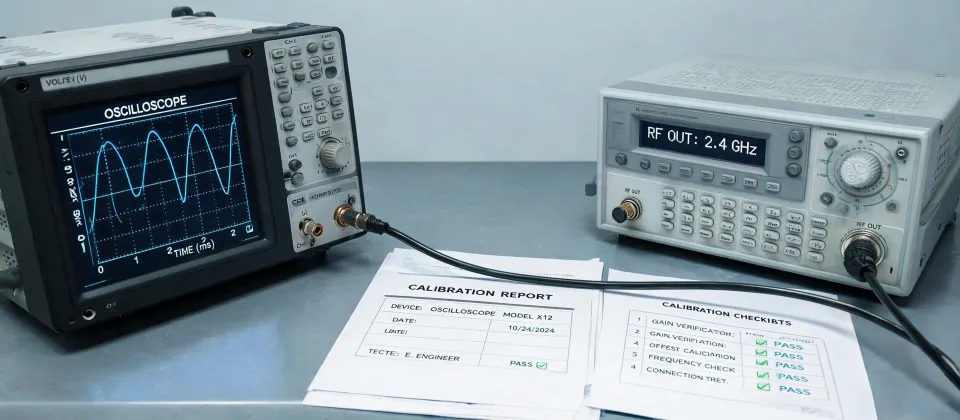
I've managed procurement for a mid-sized electronics R&D lab for going on seven years now. Over that time, I've processed over 180 purchase orders for test equipment — oscilloscopes, spectrum analyzers, probes, you name it. My annual budget runs around $85,000, which sounds like a lot until you're staring down a quote for a new mixed-domain oscilloscope.
Here's what I've learned: there's no single "best" Tektronix instrument. It depends on what you're measuring, how often you measure it, and — maybe more than most engineers want to admit — your budget reality.
So let me break this down by scenario. Each one comes from a real purchasing decision I've made (or regretted) in the past few years.
Scenario A: You're debugging high-speed digital designs
If you're working with modern microcontrollers, FPGAs, or high-speed serial buses (USB 3.0, PCIe, Ethernet at 1 Gbps+), your oscilloscope bandwidth needs to be at least 5x your signal's fundamental frequency. That's not marketing talk — it's basic signal integrity math. A 1 GHz clock? You're looking at a 5 GHz scope minimum.
What I'd recommend: The Tektronix MSO64 series (6 GHz bandwidth, 25 GS/s). It's not cheap — we're talking $30k+ fully loaded — but compared to the Keysight equivalent, it's often 15-20% less for similar specs. We bought one in 2024 for our R&D team, and it's been a workhorse.
What vendors won't tell you: The included probes matter more than the scope specs in many cases. A 6 GHz scope paired with a 1 GHz probe is a $30k mistake. Budget for the right probes — Tektronix TAP3500 or TDP7700 series for high-speed differential signals. They're not cheap (around $3-5k per probe), but cheap probes will kill your measurements.
My regret: In 2022, I approved a purchase of a 2.5 GHz scope for a project that eventually needed 5 GHz. We had to spend another $18k on a second scope. That $8k "savings" cost us $18k. (Fortunately, we use the 2.5 GHz scope for power analysis now, so it's not wasted.)
Scenario B: You need a spectrum analyzer for EMI pre-compliance or RF work
Spectrum analyzers are a different beast. For EMI pre-compliance testing to FCC/CE standards, you need:
- Frequency range covering at least 30 MHz to 1 GHz (for conducted emissions, plus 1-6 GHz for radiated)
- Resolution bandwidth (RBW) down to 10 Hz or lower for identifying narrowband interference
- A tracking generator (or at least the option for one) if you're doing filter characterization
What I'd recommend: The Tektronix RSA500 series (3.2 GHz or 6.2 GHz models). For about $8-12k, you get a real-time spectrum analyzer with up to 40 MHz real-time bandwidth. That's a fraction of what a traditional benchtop SA costs. We bought one for our compliance lab in 2023, and it's been our go-to for pre-scanning.
An insider tip: If you're only doing pre-compliance (not full certification testing), the RSA500 series is plenty. But if you need formal compliance reports — the kind that gets your product into retail — you're probably going to hire a certified lab anyway. Don't overbuy for in-house work.
Reverse validation moment: I almost bought a used Keysight SA for $5k off eBay. My team warned me about calibration. I didn't listen. The unit arrived, and the calibration had expired two years prior. The cost to recertify? Almost as much as a new RSA500. We sent it back. Costly lesson.
Scenario C: You're doing general-purpose troubleshooting and teaching
Not every lab needs top-tier specs. For university teaching labs, general troubleshooting, or basic analog circuit work, a scope in the 100-200 MHz range is often sufficient. The question is: how many channels, and what kind of probes?
What I'd recommend: The Tektronix TBS2000B series (100 MHz or 200 MHz, 4 channels). With a 7-inch display and up to 2 GS/s sample rate, it's solid for most daily work. Price is around $1,500-2,500 depending on configuration.
Here's the budget reality: For a teaching lab with 20 benches, the TBS2000B at ~$1,800 each is $36,000. That's before probes. The cheap option — a $400 scope from a no-name brand — might save $28k upfront. But when three of them fail in the first semester (which happened to a colleague), the downtime and replacement costs eat that "savings" fast.
My rule of thumb: For labs that run 8+ hours a day, 5 days a week, buy Tektronix. For occasional use (2-3 hours/week), you can go cheaper. But check the warranty — Tektronix offers 3 years standard on most scopes, compared to 1 year on budget brands.
Scenario D: Specialized probes and accessories
This is where I've seen people waste the most money. They buy a $5,000 oscilloscope and then spend $8,000 on a single current probe (the TCP0030A, for example). Or they buy a $200 universal probe that introduces 50 MHz of noise into their measurement.
What I'd recommend: Match the probe to the measurement, not the scope. A Tektronix TPP0250 (passive, 250 MHz) is about $250 and fine for most bench work. But if you're measuring ripple on a 5V power supply (millivolts at switching frequencies above 100 kHz), you need a low-noise differential probe like the TDP1000 — at $1,500, it's expensive but necessary.
What most people don't realize: Some probes have a "specification bandwidth" that's only achievable with certain scopes. A probe rated for 500 MHz may only deliver 300 MHz on a 100 MHz scope. Always check compatibility in the Tektronix Probe Selector (available on their website).
How to decide which scenario fits you
Here's a quick decision framework I use before any purchase:
- What's the highest frequency signal you'll measure? Multiply by 5 for scope bandwidth. For spectrum analyzers, your max frequency needs to cover your fundamental plus at least the 5th harmonic of interest.
- How many hours per week will it run? More than 20 hours? Invest in quality. Less than 10? Consider a mid-range model.
- Do you need to measure differential signals? If yes, budget for differential probes (they're not optional).
- What's your calibration budget? Every instrument needs recertification every 1-2 years. Factor that into TCO.
- Can you justify the spend? If the purchase saves 50 engineering hours per year at $100/hour loaded cost, that's $5,000 in labor. That alone often justifies a mid-range scope.
In my experience, the $500 "deal" on a used instrument without calibration history is usually $1,500 of regret. And the $15,000 scope that sits unused because it's too complicated for the technicians who need it? That's a different kind of waste.
So start with your use case. Not the spec sheet. Not the brand (though Tektronix has been solid for us). And especially not the lowest quote.
Marcus Feld
Marcus Feld is an electrical test and measurement analyst specializing in multimeters, oscilloscopes, clamp meters, insulation testers, spectrum analyzers, and data loggers. He applies IEC 61010-2-030 and IEC 61010-031 concepts while examining measurement category, bandwidth, true-RMS response, input loading, and stated uncertainty. His work helps maintenance engineers and test teams choose safe instruments with performance suited to the signals and environments they actually measure.
Leave a technical comment