Buying a Used Tektronix Oscilloscope: Worth It, With One Condition
Posted on 2026-08-14 by Marcus Feld
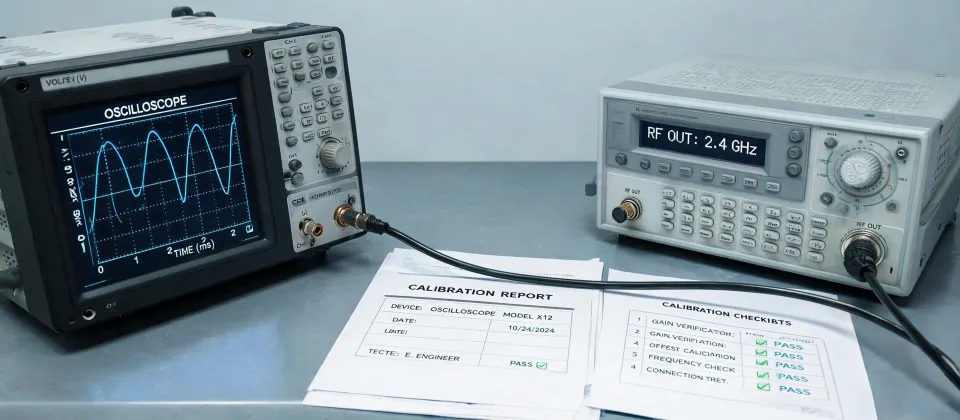
A used Tektronix oscilloscope is worth buying, but only as a known quantity, not a gamble. In six years of managing procurement for a 40-person engineering lab, I've purchased three used scopes at roughly a third of their new-equivalent cost. All three are still on the bench. I've also watched a colleague save $220 on a Tektronix 2246 oscilloscope that arrived with a dead channel, a scratched CRT, and a seller who stopped answering. That contrast—$220 saved versus a scope that couldn't do the job—is the whole debate in two examples.
Here's the number that matters: the gap between a cheap as-is 2246 and a tested, calibrated unit is usually $150–300—and that's the best-case cost of the cheap one arriving dead. Best case, because you also lose the week of schedule and the expedited replacement shipping. The real question isn't “used vs. new.” It's “known-good used vs. unknown used.”
So the direct answer to “is a used Tektronix oscilloscope worth it?” is yes, routinely. With one condition: you have to price in certainty, not just the listing price.
Why I'm Confident in That Answer
I'm the person who signs off on equipment purchases at a mid-sized engineering company. I've managed our test equipment spending for six years—roughly $60,000 annually, with oscilloscopes and accessories taking a consistent slice. Every order goes into a cost-tracking spreadsheet I built after getting burned once. I skipped the calibration check on a “bench-tested” analyzer because the price felt like a steal. It was—for the seller. The unit produced sloppy readings, and the rework cost us $1,200.
In Q2 2024, I compared quotes for a used spectrum analyzer across four vendors. The lowest was $4,200. The second-lowest was $5,100, and it included calibration documentation plus a 90-day warranty. I nearly went with $4,200. Then I did the math on what calibration would cost separately: $650 and a two-week lead time. The “$4,200” analyzer was $4,850 with the same certainty as the $5,100 one.
That's the framework I've applied to every used test instrument since, including oscilloscopes.
The Tektronix 2246 Oscilloscope: A Case Study in What “Cheap” Really Means
The 2246 is the classic used-scope entry point. It's a 100 MHz, four-channel analog scope that Tektronix introduced in the late '80s—or rather, kept in production well into the '90s because it sold that well. It has on-screen readouts, cursors, and enough bandwidth for a large chunk of today's embedded and audio work.
I've been tracking used Tektronix oscilloscopes for sale for years. 2246s run anywhere from $150 to $500 depending on condition, accessories, and whether the seller understands what they're selling. The difference between the $150 unit and the $500 unit is rarely visible in the photos.
Here's something sellers won't tell you: “tested” usually means “it powers on.” It doesn't mean all four channels meet spec. It doesn't mean calibration is current. It doesn't mean the attenuator knobs aren't skippy. Per FTC guidelines (ftc.gov), claims like “tested” and “fully functional” have to be substantiated. But what that substantiation looks like in practice is rarely shared with the buyer.
I've learned to ask a pointed question: “What does tested mean? Send me a photo of a known signal on each channel.” The sellers who send that photo get my money. The ones who say “it worked when I stored it” get a polite pass.
Where the Savings Disappear
The classic mistake in used-scope math is comparing the quoted price to the price of a new scope. That's a fair starting point, but it's not the real comparison. The real comparison includes what it costs to make the used scope trustworthy.
- Calibration. A scope without current calibration is an instrument with an opinion, not a measurement. Calibration runs $150–300 per unit and takes time. The $200 2246 with a 2021 calibration sticker isn't a $200 scope.
- Probes. The listing says “scope only.” Good 100 MHz probes run $50–200 each. Four-channel scope, four probes. That's a line item.
- Shipping. A CRT scope in the mail is a roulette spin. Unless the seller packs it like a vase, you're gambling on transformers surviving freight.
- The redo cost. If a scope fails incoming inspection, you're not out just the purchase price. You're out the engineer's week of waiting, plus the cost of the replacement.
It's tempting to think the choice is simply “used vs. new.” But the category a lot of buyers ignore sits right between them: “used, with a warranty.” Resellers who specialize in used Tektronix gear charge more than private sellers—and they earn it with a 30-day return policy and a documented calibration check. Not ideal, but workable. Actually, “workable” undersells it. For a lab with deadlines, it's the rational middle.
The Certainty Premium Is Not a Premium
I'll go further: when you have a hard deadline, the more expensive used scope is the cost-control move.
In March 2024, we needed a third working scope for a week of verification testing ahead of a compliance submission. I had two options. Option A was a $180 2246 from a private seller, no returns, ship time uncertain. Option B was a $495 unit from a used-instrument dealer, with calibration documentation, a 30-day warranty, and guaranteed delivery by Thursday. I went with B.
That's a $315 difference. I didn't sleep great that night. I hit “confirm” and immediately wondered if I could have pushed the price lower. But the calculation was brutal and simple: if Option A arrived broken, the fastest realistic replacement was still a week out, and the compliance miss would have cost more than every scope purchase we made that year combined. The certainty cost $315. The uncertainty could have cost $15,000.
Uncertain delivery dates are a cost. An out-of-calibration reading is a cost. The scope that “works fine on the bench, trust me” is a cost, because trust is not a delivery date. When the schedule matters, the money you spend to eliminate those risks isn't a premium. It's the opposite of waste.
The Same Logic Applies Beyond Oscilloscopes
This framework has saved me more than once on purchases unrelated to scopes. When I priced out a centrifuge upgrade last year, the 5810r refrigerated centrifuge looked expensive next to the budget option. But the budget unit's reliability on long runs and its slower service turnaround made the total cost higher over three years. The TCO spreadsheet caught it before the PO went out.
Even a simple 0-12 micrometer set follows the same rules. Every micrometer drifts; the question is whether your set ships with a calibration certificate or just a nice carrying case. I've had QA catch an out-of-tolerance reading from a budget set, and the re-inspection cost comfortably exceeded the upgrade to a trustworthy one.
I could even point to something as mundane as a Sensus digital water meter on a test rig. Knowing how to read a Sensus digital water meter correctly—all the display screens, the units, the decimals—is part of the data-quality chain. Misread it and the data is wrong, and wrong data is a line item. The instrument was never the variable. Your confidence in what it told you was.
What I mean is this: every purchase is a data-quality decision, and data quality has a price. The principle is to pay for the level of certainty your schedule demands.
When the Cheap Gamble Actually Makes Sense
Now the honest boundary, because I don't want this to read as a blanket endorsement of spending more.
If you're a hobbyist with no deadline, a $150 2246 with a couple of flaky channels is a bargain. You can troubleshoot it, replace capacitors, and learn something. If you're buying a parts unit to keep an identical scope alive, sure. If the loss of $150 on an as-is gamble is acceptable to you, go for it. I've made that exact trade at my own bench.
But a lab with a project schedule and a customer-facing commitment is a different environment. At work, I've never once regretted paying for the tested unit. At home, I've resurrected two cheap scopes and enjoyed every soldering session. The variable that separates those two situations is whether there's a deadline on the other side of the price.
The hobbyist can absorb a dead scope. The lab can't. Buy the certainty when the date matters—it's the most cost-effective decision I make all year.
Marcus Feld
Marcus Feld is an electrical test and measurement analyst specializing in multimeters, oscilloscopes, clamp meters, insulation testers, spectrum analyzers, and data loggers. He applies IEC 61010-2-030 and IEC 61010-031 concepts while examining measurement category, bandwidth, true-RMS response, input loading, and stated uncertainty. His work helps maintenance engineers and test teams choose safe instruments with performance suited to the signals and environments they actually measure.
Leave a technical comment