The $22,000 Caliper Mistake: Why Total Cost Trumps Sticker Price in Test Equipment
Posted on 2026-09-04 by Marcus Feld
I watched the repair invoice get approved and felt my stomach drop. Two visits to a customer plant. One rushed motor shipment. Eleven hours of overtime. And a part that wasn't broken.
Total: $22,000.
The cause wasn't a defective motor or a failing encoder. It was a handheld digital caliper with no calibration sticker. That one tool sent us down a path that cost more than our entire annual calibration budget.
I'm a quality manager at an automation-equipment manufacturer. I review every bench instrument and field-service tool we use—roughly 200 devices a year. In 2024, I rejected 8% of first deliveries because they lacked calibration data or didn't match the specification we ordered. I used to think that was thorough. That invoice changed my mind.
The Caliper That Made Me a Total-Cost Believer
The problem started with a SICK DBS60 encoder on a customer's packaging line. The line kept stopping at the same point in the shift. The PLC alarm said it was missing encoder pulses, so we sent a technician with a spare DBS60 to the site. He swapped the encoder, and the line ran for about an hour. Then the same alarm returned.
Next, the technician suspected a mechanical issue. He measured the motor shaft with the caliper in his tool kit. It read 0.003 inch undersized. The line was down, and the customer was pushing. I asked, 'Do you trust that reading?' He said, 'No, but it's the only caliper I have.' I let the replacement move forward anyway.
You know what happened. The new motor didn't fix the line. When we got the old motor back, our mechanical inspector measured the same shaft with a certified Mitutoyo Digimatic caliper. It was within tolerance. The motor was healthy. The uncalibrated caliper had a zero offset from being dropped in the field.
Why a Tektronix Function Generator Was Worth the Extra Money
By then, the true problem was still hidden. The line fault was electrical, not mechanical—a chafed brake-resistor cable was intermittently arcing into the DBS60 encoder cable.
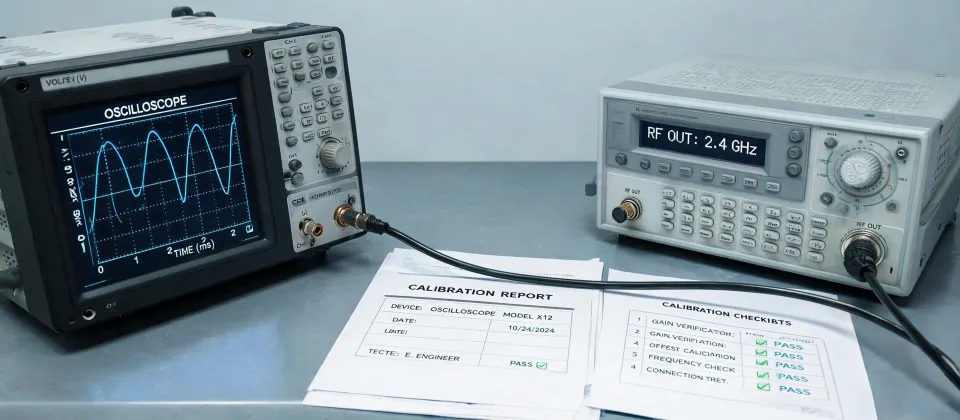
To find it, our controls engineer set up a test on the bench. He connected a Tektronix function generator to the PLC encoder input and created two square waves with a 90-degree phase offset, the same pattern a DBS60 encoder sends. If the PLC counted cleanly, the controller was fine and the problem had to be in the field cable between the encoder and the PLC.
The Tektronix function generator ran that test for 40 minutes and didn't miss a single pulse. That ruled out the PLC. Then the engineer connected the actual cable from the machine, and the faults immediately started showing up.
Why not the other function generator on the shelf? We had bought a lower-priced unit two quarters earlier as a trial. It was fine for simple waveforms, but it couldn't hold the phase relationship between two output channels at the pulse rates this test required. Instead of a clean A/B signal, we saw drift that looked exactly like the intermittent faults we were chasing. A false diagnosis would have cost another service visit.
The $400 price difference between the two generators sounded reasonable in a purchasing meeting. It disappeared beside one day of a controls engineer's time. I'm not saying every low-cost function generator is a bad tool, but I am saying total cost includes your risk when it matters.
A Tektronix Handheld Spectrum Analyzer and a Cable Tray
Finding the actual source required two more instruments. First, our engineer used a Tektronix handheld spectrum analyzer to watch the electrical noise during machine operation. The noise burst happened only when the brake engaged. I'm not an RF engineer, so I can't explain the spectral signature in detail. What I can tell you from a quality-manager perspective is that the analyzer answered the question: the fault was not coming from the PLC.
Second, a thermal camera showed where the damaged cable was heating up inside the cable tray. That hot spot matched the noise burst. Once we replaced the chafed cable, the DBS60 signal was clean. The machine ran for eight weeks without a single alarm.
What the Topdon vs FLIR Thermal Camera Debate Taught Me
That experience convinced me we needed a thermal camera in every field technician's kit. The first decision was the Topdon vs FLIR thermal camera question. Spec sheets looked similar at the price points we were comparing. The Topdon unit had more pixels and cost less. The FLIR unit would cost about twice as much, but it came with software that exported radiometric images into the report format our quality system requires.
If you only care about hot and cold spots, the Topdon may be all you need. But our field techs were going to use it to make decisions about warranty, customer safety, and root-cause analysis. In that context, the software and calibration workflow were not add-ons. They were part of the measurement. We bought the FLIR.
That's the total-cost lesson I keep relearning. The instrument that gives you an answer you can defend is the one that is actually cheap.
What I Check Before I Order Anything Now
I no longer compare test equipment by list price first. Before I sign a PO, I run through the same questions:
- Can I get a calibration certificate and a defined calibration interval?
- Does it reduce the chance of a bad service diagnosis, or only make the diagnosis faster?
- What is my time worth if a reading is wrong?
Those questions would have stopped the $22,000 caliper mistake. The uncalibrated caliper wasn't cheap, even though it was inexpensive. The Mitutoyo Digimatic calipers we use now have a calibration sticker and a serial number we can trace. The Tektronix function generator in the lab has a documented signal path. The Tektronix handheld spectrum analyzer has a recognized place in our troubleshooting procedure. The thermal camera has the software and calibration support we need.
I don't have hard data on how many less-dramatic errors that old caliper caused over the years. I wish I had kept a log. I can tell you anecdotally that it's the only tool I've ever seen turn a healthy motor into a $22,000 service event.
If you've ever watched one bad measurement create an entire chain of bad decisions, you already know why this matters. The next time someone says, 'Let's go with the lower price,' ask: lower price for what? If the answer is 'a measurement,' total cost is the only number that should matter.

Marcus Feld
Marcus Feld is an electrical test and measurement analyst specializing in multimeters, oscilloscopes, clamp meters, insulation testers, spectrum analyzers, and data loggers. He applies IEC 61010-2-030 and IEC 61010-031 concepts while examining measurement category, bandwidth, true-RMS response, input loading, and stated uncertainty. His work helps maintenance engineers and test teams choose safe instruments with performance suited to the signals and environments they actually measure.
Leave a technical comment