Don't Compare a Clamp Meter 323 With a Tektronix Oscilloscope—Compare Total Cost
Posted on 2026-09-04 by Marcus Feld
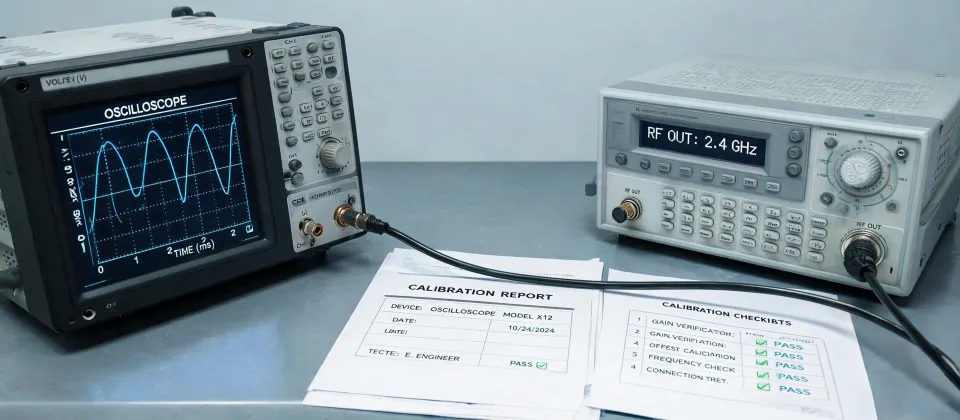
Earlier this year, a purchase request crossed my desk with two rows: a Fluke 323 clamp meter in one row and a Tektronix oscilloscope in the next. Under the justification field, the requester typed 'one for maintenance.' That was it. No measured input, no use case, no expected accuracy. I laughed for a second, but only for a second. This is how expensive test-equipment decisions hide their cost.
Quick background on why I get a vote: I'm a quality/compliance manager. Every instrument that enters our stock is reviewed before it's assigned to a technician—roughly 250 pieces a year. During our Q1 2025 quality audit, I rejected 6% of first deliveries because calibration documentation was incomplete or missing. I'm not a circuit designer, so I won't pretend to know every measurement nuance. But I do know the difference between a tool that answers a question and an invoice that only looks reasonable.
The total cost of ownership isn't the invoice total. The cost of a wrong measurement is often written in downtime and rejected product.
The wrong comparison framework
When people search for a clamp meter 323 or Tektronix video test equipment, they usually compare price lists. That is the wrong first move. A field clamp meter and a lab oscilloscope are not direct competitors. They answer different questions.
A Fluke 323 clamp meter is a field tool. It tells you if current is flowing, roughly how much, and whether a basic electrical check passes. A Tektronix oscilloscope is a time-domain instrument. It shows you what the signal does over time: edges, glitches, dropouts, noise, pulse width. Those are two very different jobs.
Dimension 1: Are you measuring a number or a waveform?
Let's start with what a clamp meter is good at. If you need to know whether a motor is overloaded, whether a heater circuit is drawing the expected current, or whether a panel is balanced, a clamp meter like the Fluke 323 is fast, safe, and practical. Its true-RMS function is especially useful when the waveform is distorted by a variable-frequency drive. For that class of work, buying a Tektronix oscilloscope would be overkill.
But a clamp meter measures the result. It does not show the shape underneath that result. It can't show you a 3 ms drop in a 24 V DC rail. It can't show you a missing pulse on an IO-Link signal. It can't show you a marginal edge that only appears when a sensor warms up or a cable is moved. Those problems need a tool that records voltage over time.
The best example I've seen was an intermittent IO-Link failure. The sensor was dropping its link at unpredictable intervals. A technician checked the supply line with a handheld multimeter and saw 24 V. Technically, the reading was correct. But when a Tektronix oscilloscope was connected, it captured a short voltage collapse every time a nearby relay switched. The multimeter couldn't see it because the event was too fast. So the sensor was blamed, then the cable, then the IO-Link master. The real problem was a power rail issue that a scope made visible in one capture.
Video testing goes one step further. For serial digital video, you are not asking 'is there signal?' You are asking 'does the signal meet timing, amplitude, and jitter requirements?' That is why Tektronix video test equipment exists. It includes dedicated waveform monitoring and signal analysis features that general-purpose scopes may not have. I'm not a video engineer, so I can't recommend a specific preset for every format. But from a quality acceptance view, if your deliverable depends on video compliance, buying the dedicated tool is a much smaller risk than trusting a generic measurement.
Dimension 2: What does repair and calibration actually cost?
This is the dimension where sticker price deceives people. Let's talk about repair.
If you own a Tektronix oscilloscope, eventually it may need service. A Tektronix oscilloscope repair quote can look expensive compared with a new generic meter. But the better comparison is against a new replacement scope, plus calibration, plus operator retraining, plus the risk of downtime. I've approved repairs that seemed high at first because the repaired unit came back with a calibration certificate and the operator already knew it well. I've also rejected repairs when the model was close to end-of-support and the repair quote was close to a replacement. There is no universal rule. The rule is to compare the full lifecycle cost.
Clamp meters need the same thinking. A low-cost clamp meter that cannot be calibrated, or that arrives without a traceable certificate, is not a measurement tool in my process. It is a guess with a display. That's why I reject deliveries with missing paperwork, even if the product looks flawless. Documentation is part of the tool.
When I calculate TCO for test equipment, I use four lines in the spreadsheet:
- Purchase price
- Calibration cost over the expected life
- Repair or replacement after failure
- Process risk if the measurement is wrong
The last line dominates most decisions. The cheapest tool is only cheap if it reliably answers the exact question you are asking.
Dimension 3: Reading the tool vs. understanding the signal
Search traffic for 'how to read a Fluke multimeter' tells me something important: many people get their first serious test instrument without a mentor nearby. I don't think that is a silly question. The buttons are small, and the difference between VAC and VDC is easy to miss when you are rushed.
But the deeper issue is that a multimeter can produce a confident number while hiding the part of the signal that matters. A Fluke multimeter is excellent for steady-state measurements. It is not designed to show whether a signal is stable over time, whether there is overshoot, or whether a communication frame is distorted. Those are waveform questions.
Likewise, an oscilloscope can be misread if the timebase or trigger is set incorrectly. But it gives more context. You can see noise, ringing, dropouts, and timing relationships. That context is usually the difference between replacing a sensor and finding the real cause of a failure.
What should you buy? Start from the job, not the brand
If you work mostly on motors, panel loads, heaters, and distribution circuits, buy a good field clamp meter. The Fluke 323 is a reasonable choice if the class of work matches its capabilities. Make sure it is calibrated and documented. Then use it.
If you troubleshoot industrial controls, IO-Link, serial buses, or intermittent production faults, get a Tektronix oscilloscope. You do not need a 2 GHz model for every job, but you need enough bandwidth and a decent trigger system. The scope will earn its space on the bench the first time a signal fails only under real operating conditions.
If you support broadcast video, production video, or digital signage, budget for Tektronix video test equipment. That purchase is not a lab luxury. It is a compliance function. A general-purpose scope may not include the specific video analysis tools you need.
If you already own a Tektronix oscilloscope and it fails, get a Tektronix oscilloscope repair quote before replacing it. Compare the repair price plus calibration plus the risk of the repaired unit failing again against a new model. Let your spreadsheet make the decision.
The next time someone sends you a request with a clamp meter and an oscilloscope side by side, don't ask which one is cheaper. Ask what signal they are trying to see, and what it will cost the operation if that signal stays hidden. That's the comparison that actually matters.

Marcus Feld
Marcus Feld is an electrical test and measurement analyst specializing in multimeters, oscilloscopes, clamp meters, insulation testers, spectrum analyzers, and data loggers. He applies IEC 61010-2-030 and IEC 61010-031 concepts while examining measurement category, bandwidth, true-RMS response, input loading, and stated uncertainty. His work helps maintenance engineers and test teams choose safe instruments with performance suited to the signals and environments they actually measure.
Leave a technical comment