Your Test Equipment Budget Keeps Overrunning: A Tektronix Procurement Manager's Take
Posted on 2026-08-31 by Marcus Feld
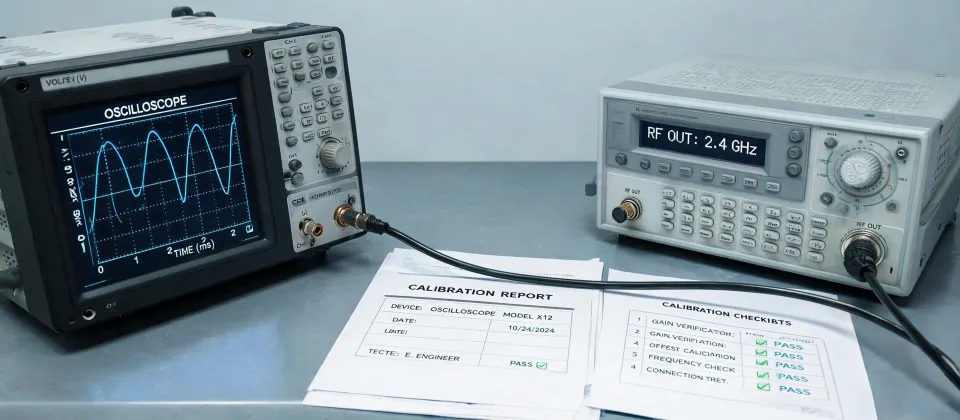
I'm a procurement manager at a 34-person electronics manufacturing company. I've managed our test equipment budget—around $180,000 a year—for six years, and I've negotiated with more than a dozen vendors. If you've ever signed a PO for a new oscilloscope and watched the final invoice land 30% above the quote, you already know why I'm writing this. Trust me on this one: the price on the quote is not the price you pay.
The surface problem is simple: test equipment costs more than it looks. The real problem is deeper. And until you fix the deeper problem, you will keep blaming the budget.
The surface problem: "The quote was wrong"
Every quarter, I see the same purchase requests. An engineer needs an oscilloscope. A technician needs a thermocouple thermometer. A maintenance lead needs a digital clamp meter. A facilities manager wants a thermal camera. Each one goes through the same cycle: find a good instrument, get a quote, approve it, and then discover the total cost of ownership was way higher than the price on the screen.
Take the Tektronix 465. It is an old analog oscilloscope with a loyal following. Every week, someone searches for a Tektronix 465 oscilloscope manual because they bought one used and want to verify the calibration. The instrument itself can be inexpensive. The manual, the correct probes, and the time spent checking it are not free. If you forget those, you don't really know what you bought.
The same logic applies to the Tektronix 422 oscilloscope. It's a portable dual-channel scope that has outlived three procurement software upgrades in our lab. When we added one, the biggest mistake I made was not budgeting for the manual and a calibration check. It sat on a shelf for two weeks because nobody knew the correct trigger settings for our application.
The deeper cause: We buy hardware when we should buy measurement capability
The pattern behind every overrun is that we treat instruments as commodities. But a measurement instrument is never just a box. It's a chain: sensor, cabling, software, calibration, training, and documentation. Skip one link and the whole chain gets expensive.
1. The instrument is not the measurement
An oscilloscope is a good example. A Tektronix scope with 1 GHz bandwidth is not a 1 GHz measurement solution if you connect it with a cheap probe rated for 100 MHz. The probe is the first thing that changes the signal. Some engineers know this. Almost nobody puts it in the budget.
A thermocouple thermometer is the classic example. It looks simple. But the reading depends on the thermocouple type, the connector, the extension wire, and cold junction compensation. Buy a thermometer from one supplier and probes from another without checking the accuracy class, and your temperature data can be off by more than you think. According to IEC 60584-1, thermocouple accuracy is classified by exact tolerance grades—it's not a vague "good enough" decision.
The T6-1000PRO digital clamp meter is another case. The manual specifies CAT IV 600 V / CAT III 1000 V ratings. That's not a marketing feature; it's a safety boundary. If I save $60 on a meter with lower ratings and use it on a distribution panel, I'm not managing costs very well. I'm making a security bet with the lab's safety.
2. Documentation is not a nice-to-have
Searching for a Tektronix 465 oscilloscope manual is intelligent, but usually someone does it only after the instrument is already in the lab. That's backwards. The manual should be part of the purchase decision. It tells you the calibration procedure, the input limits, and the test points you should expect to see. The same goes for a used Tektronix 422 oscilloscope: the manual is the difference between a working tool and an expensive paperweight.
I've made this mistake myself. Looking back, I should have bought the manual and the calibration checklist with the Tektronix 422 at the beginning. At the time, it seemed simpler to save $150 and "figure it out." We spent two weeks troubleshooting a trace issue that a calibration note would have answered in an afternoon.
3. Skill is part of the cost
You can buy a FLIR thermal camera, but if you don't know how to use it correctly, the images are useless or worse, misleading. Emissivity, reflected temperature, and thermal range all affect the result. That's why people search for "how to use FLIR thermal camera" instead of just reading the quick-start card. Good thermal imaging takes a little learning, and that learning takes money or time—usually both.
The same applies to a simple thermocouple thermometer. I once watched a technician use a type K probe rated for 300°C on a surface that was probably 400°C. The reading drifted, the probe failed, and the test had to be redone. The operator knew how to read the display. He didn't know the probe's limits. That wasn't an equipment failure. It was a training gap with a cost attached.
The price of not fixing this
Let me give you a concrete example from Q2 2024. I compared quotes for a portable oscilloscope and accessories from two vendors. One quoted $3,850 total—scope, two passive probes, carrying case, calibration certificate. The other quoted $3,150 for the scope alone. A $700 difference is hard to ignore. But the second quote didn't include the accessories: two probes added $340, the case added $120, and calibration and shipping added $190. The real total was $3,800. That's 17% hidden in add-ons, and I only found it because I asked for an itemized quote.
Cheap failures are worse. We once bought a budget thermocouple thermometer to fill an urgent order. It failed within a month. The temperature logs it produced could not be trusted, and we had to repeat 38 hours of production testing. The redo cost around $1,200 in labor. The thermometer cost $80. That was not a money-saving decision.
The pattern is clear: every time I skip the manual, the calibration, or the training line item, it comes back to bite me. The cost may show up as a failed audit, a rework test, or a scope that doesn't trigger correctly and quietly wastes a week.
What I do now: TCO before PO
Here's the thing: I'm not saying you should always buy the premium brand. The point is to compare total cost of ownership. In fact, our procurement policy now requires quotes from at least three vendors, and I built a simple TCO spreadsheet after getting burned on hidden fees twice (note to self: I still owe the team a vendor scorecard update). It has saved us a ton of time and one very bad Tuesday.
Before any test equipment order, I use a checklist:
- What measurement problem are we solving? "Need an oscilloscope" is not an answer.
- What accessories, probes, sensors, and software are required for that exact measurement?
- What documentation do we need? Manual, calibration certificate, application note, or service guide?
- How will the team learn to use it? For a T6-1000PRO clamp meter, that might be a 20-minute safety review. For a thermal camera, it might be a practical training session.
- What is the calibration or maintenance plan over the next three years?
If the answer to any of those questions is "I don't know," that's a red flag. I'd rather spend 10 minutes explaining options than deal with mismatched expectations later. An informed customer asks better questions and makes faster decisions.
This isn't about avoiding lower-priced vendors. It's about making the real costs visible. If the lower quote is still lower after adding everything, I'll take it. Sometimes the cheaper option is genuinely better. But I won't make that call based on a base price.
I went back and forth between two oscilloscope vendors for two weeks. On paper, the lower-priced brand made sense. But my gut kept saying the documentation and support were worth the extra money. In the end, we chose Tektronix. I don't regret it. That's not a blind brand loyalty statement. It's a total-cost decision where the manual and support made the difference.
There's something satisfying about a purchase that lands on budget and works the day it arrives. After years of budget surprises, that's the payoff. No last-minute change orders. No "we didn't think we needed that." Just a clear spec, a complete order, and a technician who can measure what he expected to measure.
Bottom line: your test equipment budget doesn't need more money. It needs better questions. The manual, the training, and the calibration are not optional extras. They are the instrument, once you count total cost.
That's where my experience has its limits. My sample is about 200 mid-range orders with commercial test equipment. If you're buying military-spec instruments or large automated test systems, your cost drivers will be different. But the principle—buy the complete measurement, not just the box—holds no matter what.
Marcus Feld
Marcus Feld is an electrical test and measurement analyst specializing in multimeters, oscilloscopes, clamp meters, insulation testers, spectrum analyzers, and data loggers. He applies IEC 61010-2-030 and IEC 61010-031 concepts while examining measurement category, bandwidth, true-RMS response, input loading, and stated uncertainty. His work helps maintenance engineers and test teams choose safe instruments with performance suited to the signals and environments they actually measure.
Leave a technical comment