Why I Stopped Buying the Cheapest Test Equipment (And You Should Too)
Posted on 2026-07-08 by Marcus Feld
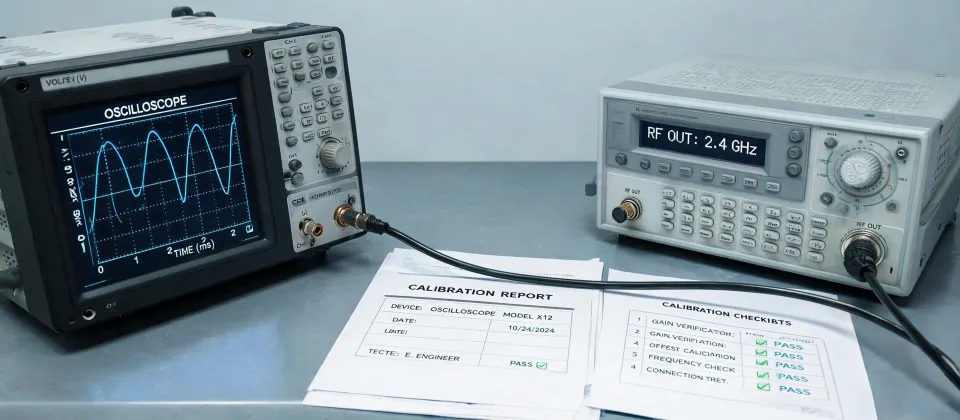
Price tags lie. Total cost tells the truth.
I manage procurement for a mid-sized engineering lab. When I took over purchasing in 2020, my first instinct was to save money. Bottom line, that instinct cost us about $12,000 in hidden expenses within the first year. So let me be blunt: choosing the cheapest test equipment is a false economy. Total value—including support, reliability, and accuracy—always outweighs the upfront price. I'll show you why.
My $200 Savings Turned Into a $1,500 Problem
I found a great price on a spectrum analyzer—$400 less than the Tektronix 2712 we'd been quoting. Seemed like a no-brainer. The vendor promised same specs. It arrived on time (surprise, surprise). But within three weeks the readings started drifting. Our lead engineer spent two days troubleshooting before realizing the instrument was out of calibration. The vendor's support was useless—they couldn't provide a valid calibration certificate or even a straight answer.
We ended up sending it to a third-party lab for recalibration at $600, plus the lost engineering time (roughly $900 in billable hours). Total cost of that "bargain": $400 + $600 + $900 = $1,900. The Tektronix unit with proper support would have been $1,200 total. I still kick myself for not spending the extra $200. That's the kind of regret that sticks with you.
The Hidden Costs Nobody Talks About
I don't have hard data on industry-wide failure rates, but based on my five years managing about 60–80 orders annually, I'd say cheap test gear fails or underperforms roughly 30–40% of the time. Here's what the sticker price doesn't include:
- Calibration drift – Lower-quality components mean more frequent recalibration. A Tektronix oscilloscope typically holds spec for 12 months; budget alternatives often need it every 6 months. At $200–400 per calibration, that adds up fast.
- Wasted engineer time – When a function generator outputs a distorted waveform, your team wastes hours debugging the signal instead of the circuit. That's time you can't bill.
- Incompatibility surprises – Cheap probes and accessories may not mate properly with your existing gear. I learned this the hard way when a "universal" probe damaged the BNC connector on a Tektronix MSO (that $30 probe caused $180 in repairs).
Oh, and I should mention: the time cost. Every hour spent chasing equipment issues is an hour your R&D team isn't innovating. That's the biggest hidden cost of all.
What Your Engineers Really Want
I process orders for 40+ engineers across three departments. When I ask what they care about, the answer is never "the lowest price." They want instruments that work reliably, that they already know how to use (like the Tektronix XYZs of Oscilloscopes guide they all reference), and that integrate with their existing software. A price-cut spectrum analyzer that requires a week to learn? That's a deal-breaker.
One of my biggest regrets: not asking the end users before I made that first cheap purchase. The engineer who got stuck with the unreliable analyzer still mentions it two years later. Equipment frustration erodes morale. And when your team can't trust their measurements, the whole project timeline gets compromised.
But What If Budget Is Tight?
I get it. Procurement targets are real. My CFO once asked why we couldn't just buy the "good enough" option. Here's what I told him—and what I'd tell anyone facing the same squeeze:
- Lease or rent – Many distributors offer short-term rentals for peak projects. You get the quality without the capital hit.
- Buy refurbished from authorized sources – A certified pre-owned Tektronix oscilloscope from an authorized reseller often costs half the new price but includes warranty and calibration. (I wish I had tracked the savings more carefully, but anecdotally we've cut 40–50% on some models this way.)
- Prioritize correctly – Don't cheap out on the core instrument (oscilloscope, spectrum analyzer) that every project depends on. Save on accessories like generic BNC cables or carrying cases—those don't affect measurement integrity.
The point is: you don't have to choose between budget and quality. You just have to be smarter about how you allocate dollars.
So What's the Right Approach?
After five years of making every mistake in the book, my rule is simple: evaluate total cost of ownership, not invoice price. Ask yourself: What's the calibration interval? What support comes with it? Is there free training material (like Tektronix's XYZs of Oscilloscopes primer—still the best free resource out there)? Will my engineers be productive on day one?
I'm not saying every purchase must be premium. For a one-off project where accuracy isn't critical, a budget option may work. But for your everyday workhorses—the oscilloscopes, spectrum analyzers, function generators—invest in reliability. The upfront premium pays for itself in peace of mind and fewer fire drills.
That cheap spectrum analyzer cost me $1,500 more than the Tektronix would have. I still have the invoice taped to my wall as a reminder. Learn from my mistake—don't let the price tag fool you.
This pricing data reflects Q1 2025 market rates. Calibration costs vary by region; verify with your local service provider.
Marcus Feld
Marcus Feld is an electrical test and measurement analyst specializing in multimeters, oscilloscopes, clamp meters, insulation testers, spectrum analyzers, and data loggers. He applies IEC 61010-2-030 and IEC 61010-031 concepts while examining measurement category, bandwidth, true-RMS response, input loading, and stated uncertainty. His work helps maintenance engineers and test teams choose safe instruments with performance suited to the signals and environments they actually measure.
Leave a technical comment