Test Equipment Buying: 7 Mistakes That Cost Me $2,800 (A Practical Checklist)
Posted on 2026-08-31 by Marcus Feld
-
Step 1: Write Down What You'll Actually Measure
-
Step 2: Add 30% to the Sticker Price
-
Step 3: Don't Buy a Vintage Scope for a Workbench
-
Step 4: Match the Meter to the Job
-
Step 5: Check the CAT Rating on a Clamp Meter
-
Step 6: Budget for Calibration Up Front
-
Step 7: Maintain the Unsexy Tools
-
Common Mistakes to Watch For
I've been handling test equipment procurement for our engineering team for six years. I've personally made—and documented—seven significant purchasing mistakes, totaling roughly $2,800 in wasted budget. Some were rushed spec decisions. Some were budget traps I walked into willingly. All of them were preventable. I now maintain our team's equipment checklist, and this is the version I hand to anyone setting up a new bench.
If you're about to buy an oscilloscope, a multimeter, or a clamp meter, work through these seven steps first. They would have saved me about a year of frustration and a lot of money.
Step 1: Write Down What You'll Actually Measure
My first mistake happened in 2018. It started with a classic error: I bought based on specs, not on the work. I asked "what's the best oscilloscope?" instead of "what signals am I debugging?"
Here's the thing: if you're working on embedded microcontrollers at 1-10 MHz, a 100 MHz bandwidth scope is plenty. If you're doing power electronics, you need higher voltage ratings and maybe isolated channels. Those are very different instruments, and neither is universally "better."
So before you open any product page, write down the three signals you measure most often—their voltage levels, frequencies, and what you need to see in them. Bring that list with you. If a sales engineer asks what you'll measure and you say "a bit of everything," you're about to overpay for specs you'll never use.
Step 2: Add 30% to the Sticker Price
When I search for Tektronix oscilloscope price, the first result is always the base unit. The base unit is not the final cost. A decent set of probes runs $200-400. Differential probes are $1,000+ each. Shipping, calibration, and accessories add more.
I now use a simple breakdown:
- Base unit: the quoted price
- +15% for probes and leads if they're not included
- +10% for calibration and shipping
- +5% buffer for the thing you didn't plan for
I applied this rule to a $3,200 Tektronix order in 2022. The accessories alone ran $680. If we hadn't budgeted for them, the project would've stalled for a week.
Step 3: Don't Buy a Vintage Scope for a Workbench
In 2021, I bought a Tektronix 547 oscilloscope off an auction site. The 547 is a legend—it was the mainframe that powered electronics labs from the 1960s through the 1980s—and the $150 price felt like stealing.
It wasn't. That $150 became roughly $550 after repairs, replacement components, and a calibration attempt by the only retired technician I could find who still worked on tube scopes. The 547 is a tube instrument. It needs a variac for safe power-up, its power supply capacitors leak with age, and the plug-in vertical amplifiers (the 1A1, 1A4, and others) are getting hard to find in working condition. In September 2022, the power supply failed entirely.
I'm not saying vintage scopes are bad. If restoring classic test gear is your hobby, the 547 is a genuinely rewarding project. But if you need a scope to get paid work done, buy a modern one. I can only speak to my experience, but the romantic appeal of a classic scope fades fast when you're debugging against a deadline and the CRT starts flickering.
Step 4: Match the Meter to the Job
It's tempting to think a multimeter is a multimeter. It's not. I own several, and I use them very differently.
On my bench is a Tektronix 15B+ digital multimeter. After two years of regular use, here's my honest review: it's an entry-level meter, and it's good at what it's designed for. The display is clear, the auto-ranging is responsive, and for quick continuity checks or verifying that a rail is present, it's perfectly serviceable.
But I don't reach for it when a measurement genuinely matters. The 15B+ has basic input protection and a wider accuracy spec than lab-grade meters. When I'm characterizing a reference voltage or validating a prototype, I use the calibrated benchtop meter. That's not a criticism of the 15B+—it's a reminder that a tool should match its job. Treating an entry-level meter as your only meter is how you end up chasing phantom failures.
Here's what I learned about value the hard way: a $40 savings on a meter can cost $400 in bench time when it gives you a reading that's "close enough" but not close enough. In my experience managing equipment purchases over the past six years, the lowest quote has cost us more in 60% of cases—through missing accessories, calibration gaps, or premature failures.
Step 5: Check the CAT Rating on a Clamp Meter
For live current measurements, a clamp meter is the tool. You don't break the circuit; you clamp around the conductor. We use a 323 clamp meter for field checks, and it's served us well for the jobs it's rated for.
Here's something many people overlook: verify the CAT rating. IEC 61010 defines the safety categories—CAT II for outlets and appliances, CAT III for distribution panels, CAT IV for service entrances. The rating tells you how much transient energy the meter can survive. A CAT II meter on a CAT III panel isn't a minor spec mismatch; it's a genuine safety hazard.
Whatever clamp meter you're considering, check the rating on the side of the device before you trust it near live equipment. The 323 covers AC current to 400 A, which we've found sufficient for motor and panel work. But the model number matters less than the rating.
Step 6: Budget for Calibration Up Front
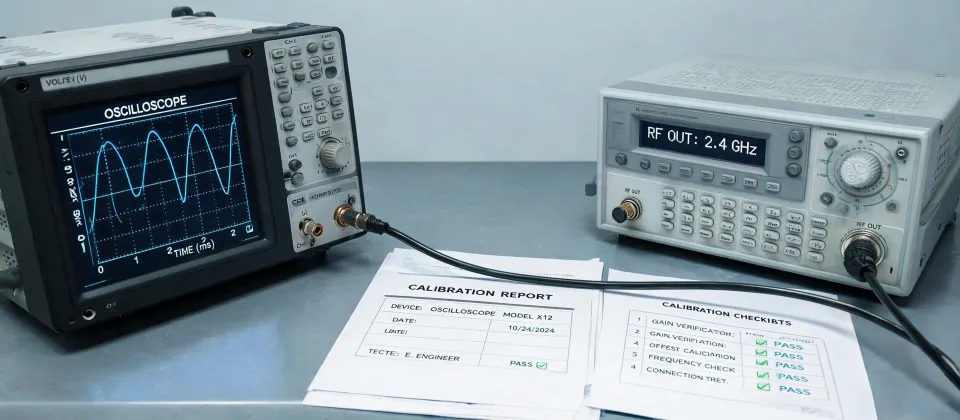
In 2021, I trusted a bench meter that hadn't been calibrated in four years. The meter displayed stable, confident readings that were off by about 12%. I spent two weeks chasing a "power problem" that didn't exist. That mistake cost $890 in wasted lab time and a 1-week delay on a delivery.
The lesson: calibration is not optional, and the cost doesn't scale with the device price. A $50 tool with a $100 calibration fee is a bad deal. A $500 tool with a $50 annual calibration fee is a great one. Always ask for the calibration quote before you buy, and always verify the calibration certificate date before accepting delivery.
What most people don't realize is that even brand-new instruments can sit in warehouses long enough for their calibration to lapse. Checking the certificate date at delivery has caught 47 potential issues for our team in the past 18 months. That habit alone has paid for this checklist many times over.
Step 7: Maintain the Unsexy Tools
This step isn't about scopes or meters. It's about the tools you use so often you forget they need maintenance.
Take digital calipers. When your Mitutoyo digital caliper shows a frozen reading or error symbols, you can often reset it yourself. For most Mitutoyo models, the procedure is: remove the battery, wait 30 seconds, reinstall it, close the jaws completely, then press the ZERO button to re-zero.
That reset has saved us more than once. Honestly, I'm not sure why it works for some failures and not others. My best guess is that a low battery corrupts the zero reference, and the reset forces a fresh one. But if the caliper was dropped or exposed to coolant, the reset won't help. That's not a battery problem; that's a service call.
The wider lesson: a measurement chain is only as good as its least-maintained link.
Common Mistakes to Watch For
Four things I'd add as guardrails:
1. Buying the display unit. If the store says "it's the last one" and it has 3,000 hours of bench time, walk away.
2. Assuming probes are universal. A probe's compensation range has to match your scope's input capacitance. I once borrowed a probe that didn't match and spent an hour wondering why my square waves were rounded.
3. Treating "refurbished" as "certified." Those words mean different things. Ask for the calibration report.
4. Saving money on channels. I bought a 2-channel scope to save $400, and then needed to debug an SPI bus—clock, MOSI, MISO, and CS—on the same screen. Some money isn't worth saving.
This checklist works for us because we're a mid-sized engineering team with fairly predictable needs. If you're doing occasional hobby work or field service, your priorities will differ. But the core principle holds: the cheapest test equipment is the piece you'll end up buying twice, and the time lost to bad measurements is never worth the money saved.

Marcus Feld
Marcus Feld is an electrical test and measurement analyst specializing in multimeters, oscilloscopes, clamp meters, insulation testers, spectrum analyzers, and data loggers. He applies IEC 61010-2-030 and IEC 61010-031 concepts while examining measurement category, bandwidth, true-RMS response, input loading, and stated uncertainty. His work helps maintenance engineers and test teams choose safe instruments with performance suited to the signals and environments they actually measure.
Leave a technical comment