Tektronix Oscilloscope Repair, Tektronix Mixed Domain Oscilloscope, and Test Equipment TCO: A Cost Controller's FAQ
Posted on 2026-08-25 by Marcus Feld
-
Tektronix oscilloscope repair: should I fix it or replace it?
-
Is a Tektronix mixed domain oscilloscope worth the money?
-
Is the 117 multimeter worth the price?
-
What about the 52 thermometer on the bench?
-
How to use FLIR thermal camera (without wasting time)
-
Why do calibration quotes vary so much?
-
The question I wish you'd ask: what does the tool cost per year?
I'm a procurement manager at a 140-person electronics company. For six years, I've managed our test equipment budget—about $180,000 a year—and I've negotiated with more than 30 vendors. I've also tracked every significant order in our cost tracking system. These are the questions I keep getting asked, plus one I wish more people asked.
- Tektronix oscilloscope repair: repair or replace?
- Is a Tektronix mixed domain oscilloscope worth the money?
- Is the 117 multimeter worth the price?
- What about the 52 thermometer on the bench?
- How to use FLIR thermal camera (without wasting time)
- Why do calibration quotes vary so much?
- The question I wish you'd ask: what does the tool cost per year?
Tektronix oscilloscope repair: should I fix it or replace it?
It depends. Not helpful? Here's the rule I use: if the repair quote is over 50% of the cost of a comparable replacement, and the scope is more than five years old, I start leaning replace. But there are exceptions.
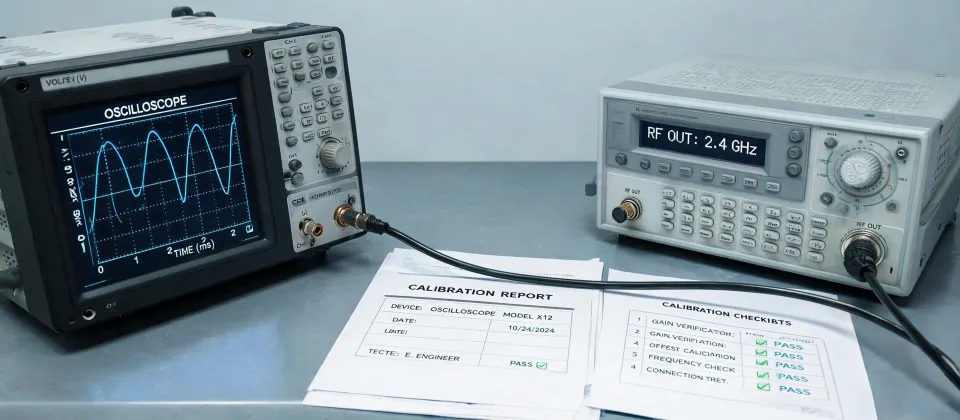
A few years ago, we had a Tektronix MDO4000 with a dead input channel. Tektronix oscilloscope repair quote: $1,150. Replacement cost: $4,300. We repaired it. The scope has been reliable since. That's a TCO win.
The reverse happened with an older DPO2000. Two trigger-board repairs in one year—$900, then $650. The second time, I finally replaced it. The 'cheap' option was not cheap.
Oh, and one thing to ask before you approve any Tektronix oscilloscope repair: does the quote include recalibration? Some repair centers quote the repair, then add a separate calibration charge. Knowing that upfront changes the math.
Is a Tektronix mixed domain oscilloscope worth the money?
Depends on what you measure. A Tektronix mixed domain oscilloscope—like the MDO3000 or MDO4000—puts a real RF spectrum analyzer input in the same box as the scope. That means you can look at a waveform in the time domain and see its frequency components at the same time, without adding a separate analyzer.
If you're working on switching power supplies, EMI, or wireless modules, that's very useful. The alternative is buying a separate spectrum analyzer, which changes the total cost: more calibration, more cables, more bench space, more training. In that world, the mixed domain scope often wins.
But not always. If you don't need the RF input, you're paying for a feature that sits unused. The question isn't 'can we afford the Tektronix mixed domain oscilloscope?' It's 'what would we have to buy and maintain if we didn't have it?' That's the TCO question.
Is the 117 multimeter worth the price?
The 117 multimeter is one of those tools that shows up on a lot of benches. It's a true-RMS multimeter with non-contact voltage detection and a few extras that matter when you work near live panels. It's more expensive than a basic meter, but the safety rating is not the place to shop on price. The relevant standard is IEC 61010-1; make sure you know what category your meter supports.
Do you need the 117 multimeter specifically? Maybe not. A CAT III rated meter with the same capabilities might be enough. The mistake I see is buying the premium meter and then skipping calibration to save money. That defeats the purpose. A meter with a stale calibration certificate is a bad decision no matter what sticker price you paid.
What about the 52 thermometer on the bench?
Ah, the 52 thermometer. The one that's been sitting in the drawer since 2009. It's a dual-input thermocouple thermometer, which means it can measure two points and show you the difference. For temperature mapping or delta-T checks, that's not a nice-to-have; it's the actual requirement.
I once replaced a 52 thermometer with a cheaper single-input unit because the price was right. It read accurately—eventually. It needed two returns to the manufacturer, plus shipping and downtime. Lesson learned the hard way. The replacement wasn't NIST traceable, either, and that became a problem during a customer audit. The old 52 thermometer had calibration documentation; the 'budget' one didn't.
How to use FLIR thermal camera (without wasting time)
First, don't just point it at a panel and start clicking. A thermal camera is a great tool, but the most common mistake is skipping the settings. Set the emissivity for the surface, stay consistent with distance and angle, and take both a thermal image and a visible-light photo in the same spot. The visible photo helps you explain the hot spot later.
If you're doing infrared inspections of electrical equipment, the ASTM E1934 guide is a solid starting point. Use a temperature reference, record ambient temperature, and look for unusual temperature differences, not absolute readings. Why does this matter? Because the same thermal image can look very different with the wrong emissivity setting. That's how good tools get a bad reputation.
From a budget perspective, a FLIR camera is not cheap. But I've seen a $2,500 thermal camera catch a failing breaker before a production shutdown. The shutdown would have cost us several times that. So glad we had it already.
Why do calibration quotes vary so much?
Because 'calibration' can mean very different things. One lab quotes 'calibration with data.' Another quotes a lower price and adds $30 for the test data report. Another includes a certificate but doesn't state that it's ISO/IEC 17025 accredited. Same service on paper, not the same service in practice.
I compared three labs for a batch of handheld meters last year. The numbers looked wildly different until I put them side by side. The lowest quote was $95 with everything included. The 'even lower' quote became $125 after data report and certificate fees. We switched labs and saved about $900 that year—but only because we compared the total scope, not just the sticker.
Good rule: ask if the lab is ISO/IEC 17025 accredited and if the certificate includes measurement uncertainty. If they can't answer clearly, that's a red flag.
The question I wish you'd ask: what does the tool cost per year?
Almost nobody asks that. They ask the purchase price, or the repair cost, or whether the quote includes shipping. The better question is: what does this instrument cost per year over its life?
Let's take a bench oscilloscope. Purchase price is only one line. Add yearly calibration, occasional repairs, downtime, training, and any probes or accessories you have to buy. Those little costs add up fast. That's why a slightly more expensive, more reliable instrument can beat a cheap one in a TCO review.
So when you're asking about Tektronix repair, or a 117 multimeter, or a thermal camera, add a second question: 'What else does this need before it's actually useful?' That will tell you more than the invoice.
Marcus Feld
Marcus Feld is an electrical test and measurement analyst specializing in multimeters, oscilloscopes, clamp meters, insulation testers, spectrum analyzers, and data loggers. He applies IEC 61010-2-030 and IEC 61010-031 concepts while examining measurement category, bandwidth, true-RMS response, input loading, and stated uncertainty. His work helps maintenance engineers and test teams choose safe instruments with performance suited to the signals and environments they actually measure.
Leave a technical comment